What actually happens at Rio Carnival?
Rio Carnival is really three events sharing a city: the samba-school parades at the Sambadrome, the free street parties called blocos, and a short season of black-tie balls. The luxury week is built on the first and third. The blocos are glorious and cost nothing, but nobody books a suite for them.
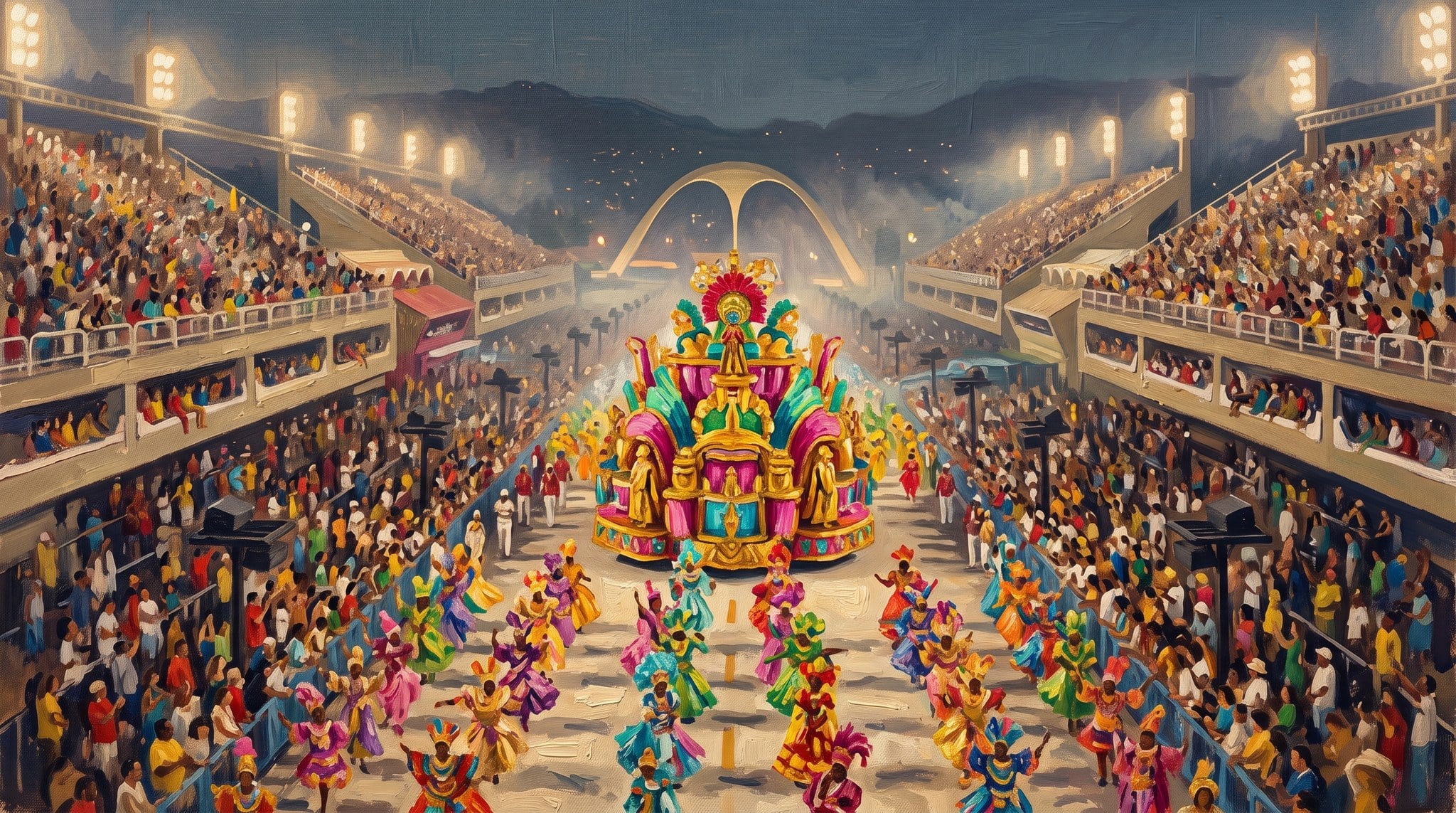
The Sambadrome, formally the Sambódromo da Marquês de Sapucaí, is Oscar Niemeyer’s 1984 parade avenue in Centro, and it is where the twelve schools of the Grupo Especial compete across three nights. A samba school, despite the name, is not a school: it is a neighborhood institution, often generations old, that spends an entire year and a fortune building one seventy-to-eighty-minute parade. Each brings thousands of costumed paraders, a drum corps of two or three hundred, and floats the size of buildings down seven hundred meters (about half a mile) of runway. Four schools parade per night, the first around 9:45 p.m. in recent editions and the last finishing toward dawn.
It is competitive in a way no outsider expects. A jury scores every detail, relegation to the second division is real, and the city treats the result roughly the way Madrid treats a Clásico. The margins are genuinely brutal: Viradouro took the 2026 title by a tenth of a point over Beija-Flor, and that single decimal is still being argued about in Rio.
What the spectacle means for your booking: this is a stadium event with stadium logistics, roughly seventy thousand people a night, and the difference between a hard concrete grandstand and an air-conditioned suite with an open bar is the difference between watching Carnival and being hosted by it. That choice, more than any other, is what this guide is for.
When is Rio Carnival 2027 — and which nights matter?
Carnival 2027 runs Friday, February 5 through Ash Wednesday, February 10, and the parades split by division. The Série Ouro, the second division, parades Friday and Saturday. The Grupo Especial, the twelve schools you have seen in every photograph, parades Sunday, Monday and Tuesday, February 7–9. The Champions Parade brings back the winners on Saturday, February 13. Those dates are confirmed by LIESA, the league that runs the top-division parades and the official ticket sale.
- The 2027 card is already drawn. LIESA drew the order in April 2026. Sunday opens with União de Maricá’s top-division debut alongside Beija-Flor, Paraíso do Tuiuti and Vila Isabel. Monday brings Mocidade, Unidos da Tijuca, Salgueiro and Imperatriz. Tuesday closes with Portela, Viradouro, Grande Rio and Mangueira.
- Tuesday is the champion’s night. Sunday is the grudge. February 9 puts reigning champion Viradouro on the avenue with Portela, Grande Rio and Mangueira, which is the heavyweight card on paper. But Beija-Flor lost the 2026 title by a tenth of a point and parades Sunday the 7th, and a school in that position does not come to make friends. If you can only take one night, take Tuesday. If you can read a room, Sunday is the better story.
- The Champions Parade is the greatest-hits night. The six best-placed schools of the year parade again from 9 p.m. on Saturday the 13th, the champion closing the avenue, and without the tension of scoring. Don’t mistake it for the budget option, because tickets price like the competition nights and the camarotes treat it as a peak. Our position, stated flat: for a first-timer who cares more about spectacle than sport, the Champions Parade is the smart buy. For everyone else it is the encore, not the concert.
Two pieces of context that will outlive this edition. First, the twelve-school format is now on a published clock: LIESA and the Prefeitura have agreed to widen the top division gradually, holding at twelve for 2027, thirteen in 2028, fourteen in 2029 and fifteen by 2030, promoting two schools from the Série Ouro while relegating one. Twelve is correct for the Carnival you are booking, and it will not be correct for long. Second, the house date discipline applies as always: Rio publishes Carnival specifics late and revises them casually. The dates and the parade order above are settled. Camarote lineups and official start times firm up through the second half of 2026, so book on the assumption the week holds its shape and treat any other pre-December detail as marketing.
Where to watch at the Sambadrome: the real hierarchy
Sambadrome seating is a caste system, and it prices accordingly: grandstands at the top, numbered chairs and the tourist sector in the middle, ground-level boxes called frisas at the runway’s edge, and the camarotes, the hosted suites, above them. Every option sees the same parade. What you are buying as you climb is comfort, service, and the company you watch it in.
| Where you sit | What it is | 2027 price | Our read |
|---|---|---|---|
| Arquibancadas (grandstands) | Open concrete terraces, unassigned within the sector | R$250 a night, sectors 2–8 and 10–11, on sale now | The city’s own seat and the actual party. Loud, hot, unpadded, and the best value in world sport. |
| Cadeiras (numbered chairs) | Individual assigned seats near the end of the runway | R$250 a night, sector 12, on sale now | Assigned comfort far down the avenue. Fine; rarely anyone’s dream. |
| Sector 9 (the tourist sector) | Prime mid-avenue assigned seats, sold directly by the league since 2026 | Held back from the August window; released later | The sensible mid-tier for a visitor who wants a guaranteed seat without suite prices. Watch for it. |
| Frisas (front boxes) | Open-air boxes of six at runway level, right on the parade | A later official window; prices unannounced | Closest to the drums and the feathers, and you feel the drum corps in your chest. Bring your own champagne service, because there is none. |
| Camarotes (hosted suites) | All-inclusive lounges above the avenue: open bar, dining, shows, security | Roughly R$1,500–5,500 a night in the 2027 sale | The luxury answer. Air-conditioning, a curated crowd, and a view the frisas can’t match. |
The buying situation as this guide files, in August 2026: LIESA’s general sale for special grandstands and numbered chairs opened on August 10 through the league’s official Ticketmaster page, at R$250 a night, capped at four tickets per buyer. Frisas, Sector 9 and the cheaper popular grandstands come in later windows. That page, or a camarote’s own site, is the only place to buy anything. If the Grupo Especial nights matter to you, this is the week to act rather than the season to think about it.
Our position, stated flat: if this is your one Carnival, split it. One camarote night, one grandstand or frisa night. The suite shows you the parade properly; the terraces show you the city that built it.
The camarotes, compared
A camarote is not a box seat. It is a private club that happens to overlook the biggest parade on earth. The marquee operations sell nightly tickets covering entry, premium open bar, dinner service, DJ sets and live shows between parades, plus the part the brochures undersell: climate control and real bathrooms at 4 a.m. Three names define the top tier.
Camarote N°1 — the flagship
Camarote N°1 is the Sambadrome’s most exclusive room and prices like it. The 2027 sale opens around R$3,400 to R$4,100 a night depending on the ticket type, and the top nights climb from there. It sits in Sector 2, near the start of the runway, and operates the four nights that matter: February 7, 8, 9 and 13. Premium open bar, a curated buffet and transfer service are included. This is where the famous faces actually are. If the point of your Carnival is to be hosted flawlessly and photographed accidentally, this is the room.
Nosso Camarote — the big-production alternative
Nosso Camarote runs the longest season of the marquee suites, spanning both parade weekends, with nightly tickets in the mid four figures and multi-night packages beyond that. It trades a little of N°1’s exclusivity for scale: bigger shows between parades, a younger and louder crowd, and more flexibility on which nights you build around. The right choice if you want the full production value without needing the most rarefied guest list.
Camarote Allegria — the value line into the top tier
Camarote Allegria covers the widest price spread of the majors: roughly R$1,490 at the bottom to R$5,490 at the top in its 2027 sale, across a 3,500-square-metre structure in Sector 11, with transfers and kit collection running from the Sheraton Grand Rio on Avenida Niemeyer. That bottom rung is one of the quiet luxuries of the season, because it buys a technical-rehearsal night: the ensaios técnicos are the Sambadrome’s January rehearsals, when the schools run the avenue at full volume for a fraction of Carnival prices, and the calendar publishes each December. If your dates can’t reach February, a rehearsal night is the closest legitimate substitute.
Booking judgment across all three: camarote sales for the following Carnival open from August, the best nights thin out by December, and prices only move in one direction. Treat the figures above as the opening bands published for 2027 rather than a quote, and buy through each camarote’s own site or its Ticketmaster page.
The Copacabana Palace ball: Rio’s black-tie night
The Baile do Copa, the Magic Ball at the Copacabana Palace, is the one night of Carnival that dresses up rather than down. Black tie or serious costume, enforced for everyone, in the ballroom of the hotel that has hosted Rio’s aristocracy since 1923. The 2026 edition fell on Carnival Saturday, ran from 10 p.m. to 5 a.m., and sold from R$3,750 for a standard entry up to about R$5,550 for the best rooms, through Sympla, the ball’s ticketing platform. Tiers sold out in sequence, cheapest first. The 2027 edition should land on Saturday, February 6, by the ball’s own tradition, and was unannounced as we filed. Recent editions have published theme and tickets by December, along with the actor or musician crowned as the ball’s queen.
Is it worth it? If a night of gowns, orchestras and Champagne inside a working legend sounds like your Carnival, there is nothing else like it in South America. If you’d rather be sequined than tuxedoed, spend the money on a second camarote night and never look back.
Can you parade in a samba school?
Yes, and it is the door nobody advertises: the schools sell places in their own parades. You buy a fantasia, the costume, which is your ticket to the avenue. You join a designated wing, and you cross the Sambadrome with three thousand others while seventy thousand people roar at you. No samba skill is required in the tourist-friendly wings, where the wing directors herd you, kindly.
Budget properly for it, because this is not the cheap option. A standard wing costume with a Grupo Especial school generally runs R$4,000–10,000, and the destaque costumes, the sculpted showpieces worn on and beside the floats, run from five figures into territory that would buy a car. The timing is stricter than the price. Schools announce their wings and open sales from around mid-October, the costumes are made to order, and the good wings are gone roughly two months before Carnival. For February 2027, October 2026 is when this decision gets made.
The premium version is choosing a school with genuine title chances and taking it seriously: attend a rehearsal at the quadra, the school’s home court, in January; learn the enredo, the year’s theme samba, from the recording; and parade like you mean it. It is the single most memorable thing money can buy at Carnival. It is also, at those prices, a real alternative to a night in a suite rather than an add-on to one.
Getting to the Sambadrome — and back out at 4 a.m.
The metro is the answer, in both directions. The Sambadrome sits in Centro on Marquês de Sapucaí, and its sectors split across two sides that do not connect: even-numbered sectors are served by Praça Onze station, odd-numbered sectors by Central do Brasil. The metro has run around the clock on parade nights every recent edition. Do not bring a car and do not plan on a taxi at the door, because the surrounding avenues close and the post-parade surge prices rideshares into absurdity.
- Know your side before you leave the hotel. Even sectors, exit at Praça Onze; odd sectors, Central do Brasil. Crossing to the wrong side at midnight is a long, crowded correction.
- Camarote guests: use the transfer. The marquee camarotes run round-trip shuttles from their own meeting points, Camarote N°1 from its accreditation point and Allegria from the Sheraton Grand Rio, and they solve the only genuinely tedious part of the night. Take them.
- Leave before the last school or after it, not during. The mid-parade exodus doesn’t exist; everyone leaves at once at dawn. Almost nobody watches the full card from a grandstand, and camarote guests drift between the view and the lounge all night. Either duck out as the final school enters the avenue, or stay for the send-off and let the first wave clear.
- Metro back to a beach-zone hotel, not a bar. The night ends at sunrise on Copacabana with coffee, not caipirinhas. You will thank us at noon.
Is the Sambadrome safe at night?
The Sambadrome itself is one of the most heavily policed places in Brazil on parade nights, and serious incidents inside are rare enough to make national news when they happen. The risk that actually concerns a visitor is the ordinary big-city kind, concentrated in the packed transit moments before and after. The rules are the same ones our Rio safety guide builds from: the phone stays put away in the crowd crush, nothing valuable rides in an outside pocket, and the group stays together between the station and the gate. Inside your sector, and above all inside a camarote with its own private security, you can relax to a degree that surprises people. Centro’s empty streets at 5 a.m. are not the place to improvise a scenic walk. Ride the metro or the transfer, both of which exist precisely for that hour.
What Carnival costs at the top end
A properly built luxury Carnival, meaning a flagship hotel, one camarote night, one grandstand or frisa night and the ball if it’s your style, is a five-figure week in reais before flights. The budget frame, stated plainly, on 2027 sale prices where they have published and the 2026 record where they haven’t:
| Line item | Reference price | Notes |
|---|---|---|
| Marquee camarote, per person per night | roughly R$1,500–5,500 (2027 sale) | N°1 at the top of the band; Allegria’s rehearsal nights at the bottom |
| Grandstand or numbered chair, per night | R$250 (2027 sale, on sale now) | Official Ticketmaster sale only, never resale; four per buyer |
| Baile do Copa | R$3,750–5,550 (2026 record) | Black tie; the cheapest tiers sell out first |
| Parading with a school (fantasia) | R$4,000–10,000 for a standard wing | Destaque costumes run into five and six figures; buy from mid-October |
| Beachfront flagship hotel | four-to-six-night minimum packages (2026 record) | Carnival week books like Réveillon: early and completely |
Where the money is best spent, in our judgment: the camarote night and the hotel. Where it is worst spent: paying scalper premiums for seats the league sells for R$250. Buy only from the official Ticketmaster page, the camarotes’ own sites, or established agencies, and treat any street or WhatsApp resale as the fraud it usually is.
Where to stay for Carnival week
Stay on the beach, not near the venue. The Sambadrome’s neighborhood is a place you parade, not a place you sleep, and the luxury Carnival pattern is a base in Copacabana, Ipanema or Leblon with a fifteen-to-twenty-five-minute ride or metro run into Sapucaí on parade nights. The full neighborhood logic lives in our guide to where to stay in Rio, and the specific properties in our shortlist of the best luxury hotels in Rio. For Carnival, the short version is that the beachfront flagships carry the week best: they absorb the city’s energy without surrendering to it.
The booking clock is the part that punishes hesitation. Carnival week behaves like Réveillon: the flagship inventory goes first, minimum stays are the rule, and by the turn of the year the choice is what’s left rather than what’s best. The 2026 record sets the shape, with the Copacabana Palace asking a six-night minimum package with ball entry bundled, Fasano five nights, and the other flagships four or five. The 2027 terms weren’t published as we filed, but the pattern holds every cycle. Book the room the moment the trip is real, because hotels cancel more gracefully than camarotes do, and remember that February is high summer: a pool matters at 35°C (95°F). For the broader season logic, our month-by-month guide to the best time to visit Rio puts Carnival in context.
Who this suits — and who should skip it
Book the Sambadrome if spectacle moves you. This is the largest annual parade production anywhere, and the camarote tier removes every hardship that used to be the price of seeing it. It suits couples, groups of friends, and anyone whose idea of luxury includes being in the middle of something enormous. The Champions Parade plus a camarote is a genuinely comfortable first Carnival, kids included.
Skip it, honestly, if crowds themselves are the problem, if a 10 p.m.-to-dawn schedule is a hardship rather than a thrill, or if your Rio is quiet dinners and empty sand. Carnival colonizes the entire city for a week, and the contrarian luxury move is to take Rio in late November or May instead, when the flagships are calm and half the price, or to spend Carnival week in Paraty while the city sings without you. Grandstand nights specifically are for the able-bodied, meaning hours on backless concrete in deep heat. If mobility or heat is a concern, the camarote isn’t an upgrade, it’s the condition of going.
Quick answers
Which night of Rio Carnival 2027 is best?
For the competition at full stakes, the Grupo Especial nights of Sunday to Tuesday, February 7–9, 2027. Tuesday the 9th carries the card on paper: Portela, reigning champion Viradouro, Grande Rio and Mangueira. Sunday the 7th carries the grudge, because Beija-Flor lost the 2026 title by a tenth of a point and parades that night. For maximum spectacle with lower stakes and a gentler crowd, the Champions Parade on Saturday, February 13 replays the year’s six best schools without the scoring tension.
How much are Rio Carnival 2027 tickets?
Official special grandstand and numbered-chair tickets are R$250 a night in LIESA’s 2027 sale, which opened to the general public on August 10, 2026 through Ticketmaster, with a limit of four per buyer. Camarote suites run roughly R$1,500–5,500 a night depending on the operation and the night. Frisas, the runway-level boxes, and Sector 9, the tourist sector, are released in later windows with prices still unannounced.
What is the difference between a frisa and a camarote?
A frisa is an open-air box of six seats at runway level, closest to the parade, with no services, so you bring or buy everything. A camarote is a hosted suite one level up: open bar, dining, air-conditioning, private security and a party between parades. The frisa is proximity; the camarote is hospitality.
What do you wear to a camarote?
Each camarote issues an abadá or dress kit, a branded shirt or outfit that is literally your entry credential, and guests style around it: shorts or light trousers, real sneakers, nothing you’d mourn. The Baile do Copa is the opposite instrument, with black tie or full costume enforced at the door.
Can you buy Sambadrome tickets at the door?
Plan as if you can’t. Official inventory sells out in advance through LIESA’s Ticketmaster windows and the camarotes’ own channels, and what circulates outside the gates on the night is resale at hostile prices with real fraud risk. Buy ahead, from official sources only.
Is the Sambadrome worth it with children?
At the Champions Parade, from a camarote or frisa, genuinely yes. The show is a child’s imagination made real, and the suite solves food, bathrooms and heat. The competition nights’ hours are the obstacle, so consider taking children for the first school or two rather than the full card, and skip the grandstands with small kids.
When do the camarotes sell out for Rio Carnival?
The marquee camarotes open sales each August, a full six months out, and the peak nights, meaning the top-division weekend and the Champions Parade, thin out first and typically by December. Booking by October is comfort; booking in January is triage.
Do you need Portuguese at the Sambadrome?
No. The parade explains itself, the camarotes staff English speakers, and the tourist-facing sales channels operate in English. Learning one phrase changes the night anyway, because each school’s enredo, its theme samba, is printed and sung seventy thousand strong. Humming the chorus of even one earns you the avenue’s instant citizenship.
Practical details
- Dates: Carnival 2027 runs February 5–10; Grupo Especial parades February 7–9; Champions Parade Saturday, February 13 from 9 p.m.
- Venue: Sambódromo da Marquês de Sapucaí, Centro, Rio de Janeiro. Even-numbered sectors via Praça Onze station, odd-numbered sectors via Central do Brasil.
- Official tickets: special grandstands and numbered chairs on general sale since August 10, 2026 at R$250 a night, four per buyer, through LIESA at ticketmaster.com.br/event/riocarnaval. Frisas and Sector 9 follow in later windows. Camarotes sell through each operator’s own site and Ticketmaster page.
- Hours: parade nights run from roughly 9:45 p.m. toward dawn on the recent pattern, with 2027 start times publishing closer to the season. The metro has operated through the night on parade dates every recent edition.
- Parading yourself: costumes open from around mid-October 2026 through each school’s own channels, R$4,000–10,000 for a standard wing, effectively gone two months before Carnival.
- Bring: the ticket QR on your phone plus a paper backup, a card for inside the venue, sunscreen for the Champions Parade’s early hours, and nothing you can’t afford to lose.
- Season context: February is high summer, with heat in the mid-30s Celsius (mid-90s Fahrenheit) and afternoon storms as the standing forecast. See our month-by-month guide to the best time to visit Rio.
Verified against LIESA’s official announcements and ticket sale, the camarotes’ own sales pages, the Prefeitura’s agreement on top-division expansion, and the 2026 apuração results, in August 2026. Carnival specifics firm up through the season, and this guide re-verifies on a standing cycle as 2027 details publish.