Ipanema: The Complete Neighborhood Guide

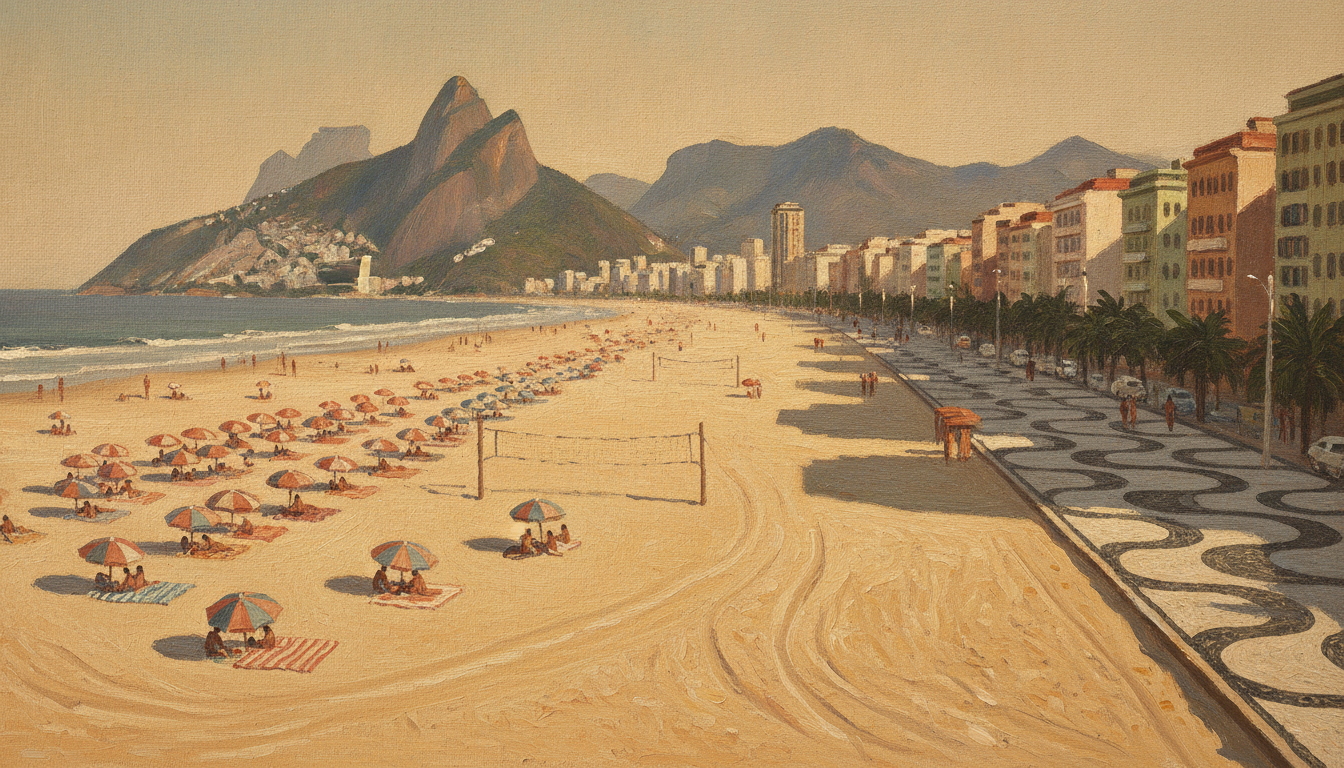
Painted illustration of Ipanema beach in Rio de Janeiro looking west along the sand, with beach umbrellas, a volleyball net, the wave-pattern promenade, and the twin peaks of Dois Irmãos rising at the far end.
Map of Ipanema, Rio de Janeiro, showing the beachfront, Rua Visconde de Pirajá, Arpoador to the east and the Jardim de Alah canal to the west.
Ipanema and its surroundings. Map data © OpenStreetMap contributors.

Why Ipanema is the default answer — and where the default breaks

Ipanema wins on geometry before it wins on anything else. The neighborhood is a shallow rectangle roughly ten blocks long and four deep, pinned between the Atlantic on one side and the Lagoa Rodrigo de Freitas on the other. You cannot get meaningfully lost in it, you can walk from the sand to the lagoon in about ten minutes, and almost everything a visitor wants — the sand, the shops, the restaurants, a metro entrance — sits inside that rectangle. Copacabana, which Riotur measures together with Leme at 4.15 kilometers of beachfront, asks you to choose a stretch. Leblon is smaller and calmer but thins out after dinner. Ipanema is the one that stays busy and still stays legible.

The default breaks in three places, and we would rather say so now than at the end. Ipanema is expensive in a way that is not always matched by what you get — a 1970s beachfront building with a tired lobby will still charge for the view. It is loud in the blocks around Rua Farme de Amoedo and Rua Vinícius de Moraes, where the bars run late every night of the week. And the western end of its sand, the stretch closest to Leblon, has measurably the worst water in the neighborhood, which we will show you with numbers further down. None of that changes the recommendation. All of it changes which block you should book on.

Where does Ipanema begin and end?

Riotur puts the beach at about two kilometers, running from the Arpoador rock in the east to the Jardim de Alah canal in the west, where Ipanema becomes Leblon. Four streets do the work:

  • Avenida Vieira Souto — the beachfront. Hotels, the highest rents in Rio, and the promenade. One side has the sea; the other has traffic.
  • Rua Prudente de Moraes — one block back. Quieter, residential, and where a lot of the better-value hotels and apartments sit.
  • Rua Visconde de Pirajá — the commercial spine, two blocks back. Banks, pharmacies, juice bars, the shopping galleries, and both ends of the neighborhood’s retail.
  • Rua Barão da Torre and the cross-streets — the restaurant and bar layer, and the reason the noise complaint above is real.

Two metro stations serve the neighborhood: General Osório, the shared terminus of Lines 1 and 4, at the eastern end by the square of the same name, and Nossa Senhora da Paz on Line 4, in the middle. Jardim de Alah and Antero de Quental, the next two stations west on Line 4, sit over the line in Leblon. That is a genuine advantage over most of Barra: from Ipanema you can reach Copacabana, Botafogo and the center without a car.

The beach, posto by posto

Rio’s beaches are addressed by posto — the numbered lifeguard stations that cariocas (Rio locals) use the way other cities use street corners. “Meet me at Posto 9” is a real instruction, not a figure of speech; Riotur’s own Ipanema listing names Posto 9 as the meeting point, and the city’s January 2026 Arpoador operation itemizes its work by “Posto 7 ao 8” and “postos 8 e 9”. The character of the crowd changes completely across those two kilometers. Choosing badly is the single most common mistake visitors make here, and it costs them the day.

Stretch Who is there Our verdict
Arpoador / Posto 7 Surfers, the sunset crowd on the rock, families early in the day The best-looking stretch in the neighborhood and the most consistent surf. Go at 7am or at sunset, not at 2pm.
Posto 8 Where Rua Farme de Amoedo meets the sand — Rio’s best-known LGBTQ+ beach stretch, and busiest at weekends Sociable, well served by vendors, and on the eastern half of the sand, where the state’s testing is kindest. Our pick for a first day.
Posto 9 The classic Ipanema crowd: cariocas, students, musicians, and everyone who came to be seen The most fun and the most crowded. Come for the atmosphere; do not expect to swim in peace or leave a bag unwatched.
Posto 10 Sport — footvolley, beach volleyball, frescobol (the beach paddle game you will hear before you see) — plus the local families from the western blocks Calmer and more organized, but this is the western end, and the western end is where the water data is worst. Fine for sun, less good for swimming after rain.

Two practical notes that most guides miss. First, on Sundays the beachfront lanes close to cars — Riotur puts the reopening at 6pm — and Avenida Vieira Souto becomes a two-kilometer promenade of runners, cyclists and skateboards. It is the best day of the week to be here and the worst day to arrive by taxi. Second, the sea at Ipanema is genuinely rough. There is a shore break and there are rip currents; the lifeguards are real and the red flags mean what they say. This is not a wade-in beach for small children.

Arpoador end or Leblon end? The water-quality answer

Every guide tells you Ipanema shades gradually into Leblon and that Leblon is the smarter address. On the sand, the state’s own testing says something more useful than that.

The Rio state environment institute (INEA) tests bathing water along the whole coast and publishes a weekly balneabilidade (bathing-water quality) bulletin. It samples Ipanema at three points — the eastern end by Rua Joana Angélica, the middle at Rua Garcia D’Ávila, and the western end near the canal at Rua Paul Redfern; Arpoador is listed separately as its own beach.

Two things are worth knowing before you pick a spot. First, Ipanema tests well: in the most recent annual record it came out best of the three headline beaches, and it is comfortably ahead of Leblon next door, which is consistently the weakest of the ocean beaches. Ipanema and Copacabana, though, trade places from year to year — treat them as equals rather than believing either is permanently cleaner. Second, the readings move week to week, and any given point can fail after a wet spell, so let the weekly bulletin decide your swim rather than a reputation.

The rule that governs all of it is rain. INEA’s standing advice is to avoid the sea for the first 24 hours after heavier rain, and to stay away from canal and storm-drain outfalls; that single habit removes most of the risk. In Ipanema the outfall that matters is the Jardim de Alah canal at the western end, where the sand runs into Leblon — so after rain, the practical move is to swim well away from it. Check the weekly bulletin before you plan a swim day — it is free, published every week, and no hotel concierge will volunteer it. Be warned that after a wet spell a bulletin can read badly across the whole Zona Sul at once. The long-run pattern is a guide to which end of the sand to choose, not a forecast for the day you arrive.

Where to eat in Ipanema

Ipanema has quietly overtaken every other neighborhood in Rio for eating, and the current MICHELIN selection settles the argument: of the eight Bib Gourmands in Rio, five are in Ipanema. Add Oseille’s star and five more Ipanema addresses in the selection, and no other Rio neighborhood is close on density.

  • Oseille — Rua Joana Angélica 155. One MICHELIN star — Rio has eight starred restaurants in all — and the guide’s top price band. Thomas Troisgros cooks a seven-course tasting menu at a sixteen-seat U-shaped counter with the kitchen in the middle. Book weeks out; this is the reservation to make before you book your flights, not after.
  • Maria e o Boi — Rua Maria Quitéria 111. Bib Gourmand, and the only one of Ipanema’s five in MICHELIN’s cheapest band. Brazilian cooking and serious cuts of beef from chef Vanessa Rocha, on a corner terrace. This is how you eat well in Ipanema without spending Ipanema money.
  • Koral — Rua Barão da Torre 446. Bib Gourmand, modern cooking, mid price band. On the bar street, which cuts both ways.
  • Pici Trattoria — Rua Barão da Torre 348. Bib Gourmand, Italian, mid band, a hundred meters from Koral.
  • Didier — Rua Vinícius de Moraes 124A. Bib Gourmand, contemporary French, mid band. The one closest to the beach.
  • Artigiano — Avenida Epitácio Pessoa 204, on the lagoon side. Bib Gourmand, and the fifth of Ipanema’s five — the one visitors miss because it faces the Lagoa rather than the sand.
  • Also in the 2026 selection, all in Ipanema: Mäska (Rua Joana Angélica 159, two doors from Oseille, modern-Mediterranean with an open kitchen), Nôa (Rua Garcia D’Ávila 135, in a 1930s house, international with Brazilian roots, upper-middle band), Rudä (Rua Garcia D’Ávila 118), Nosso (Rua Maria Quitéria 91) and Spicy Fish (Rua Maria Quitéria 99).

Note what that list does to your walking. Joana Angélica, Maria Quitéria, Barão da Torre and Garcia D’Ávila are four adjacent streets, and they hold a star, three of the five Bibs and five more guide entries inside a ten-minute walk of one another; Didier is one street further toward the beach, and Artigiano sits over on the lagoon side. That density is the real argument for staying here, and it is the argument no other Rio neighborhood can make.

One correction worth making, because half the internet has it wrong: the Fasano‘s dining room is Gero Rio. A great many guides still send you to Fasano Al Mare, and the hotel’s own site no longer lists that restaurant in Rio. The rooftop Pool Bar is guests only, so do not plan an evening around it.

What to skip: the beachfront kiosks along Vieira Souto for anything other than a drink. They are perfectly pleasant for a beer and a coconut with your feet in the sand at 4pm, and they are an expensive, indifferent place to eat dinner. Walk two blocks inland instead — the price falls and the cooking improves.

The shopping spine: Visconde de Pirajá and Garcia D’Ávila

Ipanema’s retail runs on two axes. Rua Visconde de Pirajá is the long one — ten blocks of everything from pharmacies and juice counters to the covered galleries, including Fórum de Ipanema at number 351, where Lenny Niemeyer keeps one of its two Ipanema stores. Rua Garcia D’Ávila, the short cross-street between Visconde de Pirajá and the beach, is the luxury block: Lenny Niemeyer’s other store is at number 149, and two of the neighborhood’s MICHELIN-listed restaurants sit on the same short run of pavement at 118 and 135. It is the one street here where window-shopping is the point.

The one appointment worth putting in the diary is the Feira Hippie de Ipanema — the Sunday craft market that has filled Praça General Osório since the late 1960s, now with more than 600 exhibitors, open 9am to 6pm. Riotur lists it as an official attraction and it is the only place in the Zona Sul where you can reliably buy something made by the person selling it. Go before 11am. After that it is shoulder to shoulder and the pickpocketing risk goes up with the density.

What does Ipanema cost?

At recent exchange rates a US dollar buys roughly five reais, so R$100 is about US$20. Against that, the fixed costs of a day here are small and the discretionary ones are where Ipanema takes your money.

  • Metro, single journey: R$7.90 — a state subsidy is currently holding the passenger fare below the approved tariff, so treat it as the price today rather than a fixed one. MetrôRio takes contactless straight at the gate — Visa, Mastercard, Elo, or a phone or watch — with no physical ticket to buy.
  • The beach is where you get caught. Chair, umbrella and coconut prices are set by each vendor and are not regulated, so there is no official table to quote and anyone quoting one precisely is guessing. What is on the record: in January 2026 Rio outlets reported Zona Sul operators charging up to R$100 a day for a lounger — and up to R$850 for a sofa on the sand out in Recreio — while the city debated imposing a price table and kiosk owners argued against it. Ask the price before you sit down, every time.
  • Dinner spans the full range. MICHELIN rates Maria e o Boi in its cheapest band and Oseille in its most expensive — both inside the same four blocks. You are not obliged to spend Ipanema money to eat well in Ipanema.
  • Hotels are the volatile line, and we will not quote you a number. Ipanema rates swing hard between the June trough and New Year’s, and beachfront properties price the view, not the room. Réveillon and Carnival carry minimum stays and prepayment terms almost everywhere on Vieira Souto. See when to visit before you fix dates.

Is Ipanema safe?

Yes, with one specific habit. On the state’s own police-district figures, Ipanema is among the calmest addresses in the city: violent crime against visitors here is genuinely rare, and in recent years the district has recorded stretches with no homicides at all. What is common is opportunistic theft — and overwhelmingly, it is phones. Thefts with no confrontation at all outnumber street robberies several times over.

That single fact should shape your behavior more than anything else on this page: keep your phone out of your hand on the street and off your towel on the sand. Two honest caveats. Recorded crime undercounts visitor theft, because visitors often do not report it — treat it as a floor. And a district is not a street: the square around General Osório at night, and the emptier blocks behind Visconde de Pirajá after midnight, deserve more care than Vieira Souto at noon. Arpoador is the same story in miniature — packed and lovely at sunset, but once the crowd thins it is not a place to linger with a phone out.

Our full treatment of the city, including the Zona Sul comparison and what to do if something happens, is in is Rio de Janeiro safe, and the neighbour next door gets the same treatment in is Copacabana safe.

The honest downsides

  • You pay the Ipanema tax. Same coconut, same caipirinha (Brazil’s lime-and-cachaça cocktail), higher price than three neighborhoods inland. The address is the product.
  • Noise. The bar blocks — Farme de Amoedo, Vinícius de Moraes, Barão da Torre — are loud until late, every night, all year. If you sleep badly, book on Prudente de Moraes or ask for a rear-facing room and mean it.
  • Traffic on the beachfront. Vieira Souto is a working avenue, not a promenade, six days a week. A “beachfront” room facing the street gets the traffic and none of the sea.
  • Water after rain. Covered above. It is a real constraint on a short trip, and it is worst at the Leblon end.
  • Arpoador now runs on a timetable. The city has fixed hours for the sunset spots: Pedra do Arpoador opens at 4am and closes at 9pm, Parque Garota de Ipanema (the “Girl from Ipanema” park) closes at 8pm, and the rock is cleared between 9pm and 11pm before Comlurb, the city sanitation service, cleans it overnight. Entry is via the Arpoador gate and the park entrance on Rua Francisco Otaviano; exit is via Alameda Via Peti. Any guide describing a free-for-all on the rock at midnight is out of date. Between 11pm and 4am the rock is closed altogether while it is cleaned.
  • December to March is genuinely crowded. The sand at Posto 9 on a February Saturday is not a relaxing place, and Réveillon (New Year’s Eve) empties Ipanema toward Copacabana for the fireworks — see the Réveillon guide.

Who should stay in Ipanema — and who should not

Stay in Ipanema if it is your first trip to Rio; if you want to walk to dinner; if you want beach mornings and restaurant evenings without a car; if you are traveling as a couple; if you want a metro at the end of the street. This covers most readers, which is why it is the default.

Stay elsewhere if you want quiet above everything — Leblon is calmer and more residential, with the water-quality trade-off above. If you want the grandest hotels and the widest range of price points, Copacabana has both, plus the Réveillon fireworks on its doorstep. If you are here for New Year’s specifically, read the fireworks-view hotel guide before you book anything in Ipanema. And if you have small children who want calm water, no Zona Sul ocean beach is the right answer.

If you are still choosing between neighborhoods, our hub — where to stay in Rio — sets them side by side.

Where to stay in Ipanema

Four properties that between them cover the realistic range. Rates move constantly and any number we printed would be wrong by the time you read it, so what follows is the part that does not move: where the building sits, what it actually is, and whether the position earns its price. For the citywide shortlist, see the best luxury hotels in Rio.

Some rate links on this page will become affiliate links once our booking partnerships go live. We are paid nothing to include a hotel, and no property here has any say in what we write about it.

Hotel Fasano Rio de Janeiro

Avenida Vieira Souto 80, on the sand at the eastern end of the beach. 89 rooms in five categories, Philippe Starck’s first Brazilian project, and an eighth-floor infinity pool the hotel sets against Arpoador, Dois Irmãos and Corcovado. The reference address in the neighborhood, and priced accordingly.

Hotel Arpoador

Rua Francisco Otaviano 177, at the Arpoador end, with a bar of its own called arp. Small and contemporary, and about as close to the water as this stretch gets — which also puts it beside the surf break, the sunset crowd and the new gate hours. Our pick for surfers and early risers.

Sol Ipanema

Avenida Vieira Souto 320, beachfront in the middle of the sand. A straightforward tower rather than a design statement — the reason to book it is the position and the sea-facing rooms. Insist on one; the rear rooms are the same price of admission for none of the view.

Ipanema Inn

Rua Maria Quitéria 27, one street back from the beach at the eastern end, with 56 rooms and a place in the MICHELIN Guide’s hotel selection. No sea view and no pool — what you are buying is the exact block this guide tells you to book, at a fraction of the beachfront price, with three Bib Gourmands inside a five-minute walk of the door.

Getting there and getting around

From Galeão (GIG) allow roughly 45 minutes to an hour to Ipanema in normal traffic, and longer in the evening peak — that is our working estimate from the road distance, not a published figure. A pre-booked transfer removes the one moment of a Rio trip that reliably produces anxiety: arriving jet-lagged with no Portuguese and choosing a car. Ride-hailing is reliable here and cheaper; the trade-off is the pickup scrum at the terminal.

Once you are in, walk. The metro runs 5am to midnight Monday to Saturday and 7am to 11pm on Sundays and holidays, which covers most of what you will do; General Osório connects you to Copacabana and Botafogo in minutes, and Line 4 runs west under Leblon toward São Conrado and Barra. For the classic day trip — Christ the Redeemer — you will want a car or a booked tour rather than public transport, and an early slot.

Quick answers

Is Ipanema better than Copacabana?

For most first-time visitors, yes. Ipanema is smaller, easier to read, better for restaurants and quieter than Copacabana without being sleepy. Copacabana wins on hotel choice, on price range, and on Réveillon.

What is Posto 9?

Lifeguard station 9, in the middle of Ipanema beach, and the most famous meeting point on Rio’s sand — Riotur’s own listing names it as the gathering spot. It is crowded, sociable and loud, and it is the correct place to spend one afternoon rather than every afternoon.

Which part of Ipanema should I stay in?

The eastern half — around Postos 8 and 9, on Avenida Vieira Souto or one block back on Prudente de Moraes or Maria Quitéria. You get the shortest walk to the restaurants, General Osório metro at one end, and Arpoador for the sunset a few minutes away.

Is it safe to swim at Ipanema?

On a clear day, at a staffed posto, between the flags — yes, and Ipanema came out best of the headline beaches in the latest annual record (it and Copacabana swap places year to year). Two things override that: rain in the previous 24 hours, and the shore break, which is strong enough to matter. Check INEA’s weekly bulletin and the flags.

Can you walk from Ipanema to Copacabana?

Yes — reckon on 20 to 25 minutes from Posto 9 over the Arpoador headland, and it is one of the best walks in the city in daylight. Take the metro or a car after dark instead.

Is Ipanema LGBTQ+ friendly?

Strongly so. The stretch of sand where Rua Farme de Amoedo meets the beach, around Posto 8, is Rio’s best-known LGBTQ+ beach, and the bars on that street run all week.

Practical details

  • Metro: General Osório (Lines 1 and 4) and Nossa Senhora da Paz (Line 4). Single fare R$7.90; 5am–midnight Mon–Sat, 7am–11pm Sundays and holidays. MetrôRio fares
  • Feira Hippie de Ipanema: Praça General Osório, Sundays 9am–6pm, 600+ exhibitors.
  • Pedra do Arpoador: open 4am–9pm; cleared 9–11pm. Parque Garota de Ipanema: closes 8pm. Entry at the Arpoador gate or the park entrance on Rua Francisco Otaviano; exit via Alameda Via Peti. City of Rio, 3 January 2026
  • Sunday beachfront closure: the seaward lanes of Avenida Vieira Souto close to traffic until 6pm. Riotur
  • Hotel Fasano: Av. Vieira Souto 80, tel. +55 21 3202 4000.
  • Emergencies: police 190, ambulance (SAMU) 192, fire 193.
  • Crime data: Instituto de Segurança Pública, monthly series by police district. ISPDados
  • Bathing-water bulletins: INEA publishes a weekly balneabilidade (bathing-water quality) bulletin for the Zona Sul at inea.rj.gov.br.

Prices, hours and rules on this page are verified on a standing cycle. Beach-vendor prices in particular are unregulated and move constantly; the metro fare and the Arpoador hours are set by decree and are the more stable numbers here.