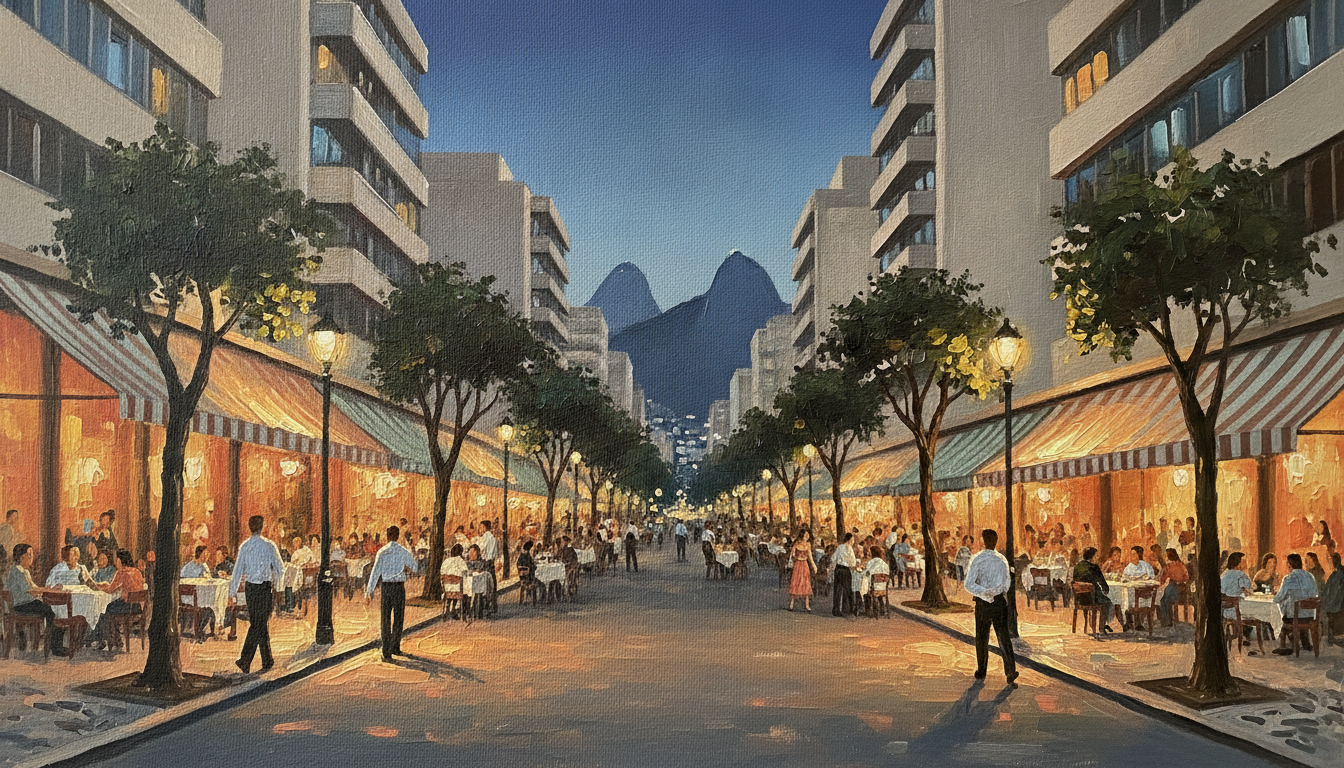
Where Leblon is, and what it actually feels like
Leblon occupies the western end of the Zona Sul beach strip, wedged between water and rock. The Jardim de Alah canal separates it from Ipanema on one side; Morro Dois Irmãos (the Two Brothers) rises straight out of it on the other; the Lagoa Rodrigo de Freitas (the lagoon behind the beach neighborhoods) sits behind it. Cross the canal and you are in Ipanema. Keep going west past the last apartment block and the road bends up Avenida Niemeyer toward Vidigal and São Conrado. There is nowhere for the neighborhood to expand, which is most of the reason it costs what it does.
The feel is residential in a way no other Rio beach neighborhood is. Copacabana is a city inside a city. Ipanema is a scene. Leblon is where people live — dog-walkers at seven in the morning, school runs, families who have been on the same block for decades, a beach that empties out by six. Two commercial spines carry most of the life: Avenida Ataulfo de Paiva, the main street, and Rua Dias Ferreira, the restaurant row. Neither is sleepy. The bars and dining rooms along them run late and fill up hard on Friday and Saturday nights — the difference from Ipanema is not quiet, it is that the noise stays on the two main streets and the residential blocks behind them stay residential. Nobody will try to sell you a hat.
How expensive is Leblon, really?
Leblon holds the most expensive residential square meter in Brazil, and it keeps holding it — narrowly ahead of Ipanema, and roughly two and a half times the Rio citywide average — R$ 28,432 a square meter on the FipeZAP index. That is the fact everyone quotes about this neighborhood, and on its own it tells a visitor almost nothing.
Here is the part travelers get wrong. That property premium does not translate one-for-one into what a visitor spends. Leblon and Ipanema are effectively level on dinner. A beach chair costs what it costs in Copacabana. Where Leblon genuinely costs more is at the top of the range — the tasting menus, the sea-view apartment rentals, the Sunday lunch with a waiting list — and it costs dramatically more in the one category where supply has nearly vanished: hotel rooms.
Who Leblon suits — and who should stay elsewhere
Leblon is right for you if you are renting an apartment rather than booking a hotel; if you are traveling with small children and want a beach with a proper playground on the sand; if this is a second or third Rio trip and you already know what you want from it; if the trip is organized around eating; or if you simply want the calmest possible base within walking distance of the rest of the Zona Sul.
Leblon is wrong for you if you want Rio’s full theater going on outside your window. The nightlife here is in the restaurants and bars — Dias Ferreira and Ataulfo de Paiva fill up properly on a Friday — rather than spilling onto the sand and the street the way it does further east. There is no samba on the corner and no beach-vendor spectacle; the beach empties in the evening and the residential blocks are genuinely residential. If the postcard version of Rio is what you came for, base yourself in Ipanema or Copacabana and come to Leblon to eat.
The restaurants: Leblon’s real case
This is the argument for Leblon, and it is not close. Rio holds ten MICHELIN stars in the current selection, and four of them are in Leblon, across three restaurants, in an area you can cross on foot in fifteen minutes. Ipanema has one — Oseille, on Rua Joana Angélica. Copacabana has one, Mee, inside the Copacabana Palace .
- Oro (★★) — Felipe Bronze’s room at Avenida General San Martin 889. Rio has only two kitchens at this level; the other is Lasai. Book weeks out, not days.
- Madame Olympe (★) — newly starred in the current selection. Claude Troisgros and Jéssica Trindade running French technique through Brazilian ingredients, at Rua Conde de Bernadotte 26.
- San Omakase (★) — an omakase counter, set menu only, also at Rua Conde de Bernadotte 26.
Read those last two addresses again. Two of Rio’s starred restaurants share a single street number — and Chez Claude, also in the current MICHELIN selection, is at the same one. The building is a small shopping gallery in the middle of Leblon, with MICHELIN’s own write-up placing San Omakase on its first floor; the three kitchens hold separate lojas (shop units) inside it. Three MICHELIN-listed rooms, one address on Rua Conde de Bernadotte. That is the clearest shorthand there is for what has happened to this neighborhood over the past decade.
What if you have not booked anything?
Walk down Rua Dias Ferreira. It is a short street of restaurants running between Avenida Ataulfo de Paiva and Avenida Bartolomeu Mitre, and it is where Leblon eats when it has not planned ahead. Sushi Leblon at number 256 has been the neighborhood’s Japanese room for decades and holds a place in the MICHELIN selection. Giuseppe Grill on Avenida Bartolomeu Mitre is the steak answer, also in the selection. Between and around them are a dozen rooms that will seat you at nine on a Tuesday without ceremony.
The counterweight: Leblon’s botequins (old-school corner bars)
A neighborhood of nothing but tasting menus would be unbearable, and Leblon is not one. Bar Bracarense, at Rua José Linhares 85 on the corner of Ataulfo de Paiva, has been open since 1961, and in 2021 it became the twenty-ninth bar admitted to the city’s Circuito dos Botequins (the official heritage circuit of Rio’s traditional bars) — a listing from the city’s own patrimony institute, not a marketing badge. It is a standing-room bar with cold beer and fried things, and it is the most useful hour a visitor can spend in Leblon. Go early evening, order at the counter, do not look for a table.
Our verdict on eating here: one starred dinner, one night on Dias Ferreira, one early evening at Bracarense. That is the neighborhood, and it is a better three-night eating itinerary than anywhere else in Rio can assemble inside walking distance.
Is Leblon beach worth it?
Yes — with one real caveat. Leblon beach is the calm continuation of Ipanema’s sand, running from Posto 11 at the canal to Posto 12 at the far end under Dois Irmãos; the postos are the numbered lifeguard stations everyone here navigates by. It is markedly quieter than Ipanema and in another category of quiet from Copacabana. Vendor traffic is light. The sunset, with the twin peaks going black against the sky, is the view most people came to Rio for without knowing it had a name.
At Posto 12 there is Baixo Bebê, a fenced play area on the sand at the foot of Rua General Venâncio Flores — playhouse, slides, swings, a pirate ship, shade, a changing table and stroller parking, all set up for small children. It has been there in some form since the mid-1990s, it is free to use, and it is maintained by the kiosk concession beside it rather than by the city, which is why the sign on the promenade carries the kiosk’s brand and not its name. Big Atlantic swells wreck it every few years and it gets rebuilt every time — the clearest sign of how much carioca (Rio local) families care about it. The kiosk itself is a business: drinks and tables are paid, as are the inflatable paddling pools. It is the most established setup of its kind on the Zona Sul sand, and a genuine reason to weigh Leblon if you are traveling with toddlers.
Keep walking west past Posto 12 and the promenade climbs onto the rocks to the Mirante do Leblon (the Leblon lookout), a free public viewing deck with a kiosk on it, looking back across the whole sweep of Leblon and Ipanema to Arpoador. It costs nothing and takes twenty minutes. Do it on your first evening rather than your last.
Can you swim at Leblon?
The caveat is the water, not the sand. Leblon has a storm-water canal at each end — Jardim de Alah to the east, Visconde de Albuquerque to the west — and both discharge onto the beach. On the state’s own per-beach records, Leblon’s water clears the swim-safety threshold less often than any other South Zone ocean beach . That is not a reason to stay out of Leblon. It is a reason to be deliberate about where and when you get in.
Rio’s state environment agency, INEA, publishes a balneabilidade (bathing-water quality) bulletin for every monitored beach, and its standing advice applies here more than almost anywhere on the strip: do not swim in the first 24 hours after heavy rain, and stay clear of canal mouths and storm-drain outfalls. In practice that means swimming in the middle of the beach rather than at either end, and staying out of the water altogether the morning after a downpour. Check the current bulletin before committing a beach day; the reading here changes week to week. If the sea is the point of the trip, Ipanema’s sand starts ten minutes east and its record is the best of the big three.
Dois Irmãos: the best view in Rio for the effort
The twin peak that closes Leblon is Morro Dois Irmãos, 533 meters, and the trail to the top gives the best return on effort of any viewpoint in the city — better than Sugarloaf for photographs, and without the cable-car queue. From the summit the whole Zona Sul lies below you: Leblon, Ipanema, the Lagoa, and Christ the Redeemer on the ridge behind.
Access runs through Vidigal, the community on the hillside above Avenida Niemeyer, and the whole operation is based there. You go up by moto-taxi or van to the trailhead, pay the mountain entry fee, and walk. The climb is about an hour up, stops included; the outing is around three hours door to door. Vidigal-based guides run departures daily — an early-morning one around 08:00 and one in the early afternoon, a slot that moves with the season. The established operator charges from R$ 160 per person for a group of two or more, or R$ 300 on your own, with the moto-taxi or van up through Vidigal and the mountain entry fee both included; not every operator bundles that fee, so ask. The meeting point is confirmed when you book, at the entrance to Vidigal off Avenida Niemeyer.
Take the early departure — better light, and you climb before the heat. And use a Vidigal-based guide rather than turning up alone: the transport up the hill and the trail access are organized through the community, going with a guide is simply how it works here, and it keeps the money in Vidigal.
Is Leblon safe?
Leblon is one of the calmest places in Rio, and it is not a bubble. Both halves of that sentence matter.
The calm half is real. This is a residential neighborhood with a doorman on every block, busy enough on the lit streets well into the evening, and it feels exactly as unbothered as it looks. One thing worth knowing before anyone quotes a number at you: no published crime figure separates Leblon from Ipanema, because the state records them inside a single police district. Anyone ranking one above the other is inventing a distinction the data does not contain.
The other half is narrower than it sounds. Leblon is not a place where phones get snatched out of hands on the main streets — that is a Centro and Lapa problem, and to a lesser extent a Copacabana one. The rule that actually matters here is about empty streets late at night: do not walk alone through the quiet residential blocks or the long unlit stretches after dark — take an Uber. Beyond that, the usual Zona Sul habits apply: take nothing to the beach you would mind losing, and treat the calm as pleasant rather than as proof of anything. For the citywide picture, read our Rio safety guide; for the neighboring comparison, Copacabana’s own read.
Getting around from Leblon
Leblon has two metro stations — Jardim de Alah and Antero de Quental, both on Line 4 — which is two more than most Rio neighborhoods manage and a quiet advantage over Ipanema. Line 4 runs east into Ipanema and west under the mountain to São Conrado and Barra da Tijuca. The public fare is a flat R$ 7.90 at the time of writing — a state decree is holding it below the approved tariff — and a contactless Visa, Mastercard or Elo card, or a phone or watch, works straight at the gate. The vans up to Rocinha and Vidigal, the hillside communities west of Leblon, integrate with the metro at R$ 8.80 on a Jaé card (the local transit card) — the integration works only with Jaé, within two hours of your first tap, and on this side of the neighborhood it is the Jardim de Alah station that offers it.
Everything else is walking or Uber. Ipanema’s General Osório is about twenty-five minutes on foot. Copacabana is a short Uber. Santos Dumont airport is half an hour without traffic and can be double that at rush hour — if you are arriving from Galeão (GIG), the international airport, with luggage, pre-book a transfer rather than negotiating at the curb.
Shopping Leblon, the neighborhood’s mall, sits at Avenida Afrânio de Melo Franco 290 by the canal, four minutes’ walk from the Jardim de Alah metro, and it is a genuinely good one — not a rainy-day fallback. Nearly 200 stores, a Kinoplex cinema and two theaters, and a food offering well beyond mall standard: IT Ristorante, Ráscal, Haoma, Zazá, Brasserie Mimolette and Ferro e Farinha are restaurants people cross the city for, not a food court. The shopping is Chanel and Brazil’s best — H.Stern, Sauer and Antonio Bernardo for jewelry, Osklen, Farm, Lenny Niemeyer, Adriana Degreas and Cris Barros for clothes — rather than a full row of European houses. Worth an hour even in good weather if shopping is part of your trip.
Where to stay in Leblon
This is the neighborhood’s real weakness, and almost no guide says it plainly: Leblon barely has hotels. The beachfront road, Avenida Delfim Moreira, once carried two large properties. The Marina Palace — the tallest building on the strip, 150 rooms — has been shut since 2017, its shell visible from the sand. Four Seasons and the asset manager Catuaí Asset have since confirmed what had been rumored for years: the building will reopen as the Four Seasons Hotel Rio de Janeiro, roughly 120 rooms and suites, with a rooftop bar and pool. The opening date they have put on it is 2029. Until then, one working hotel on the Leblon beachfront — the rest of the neighborhood’s small hotel stock sits inland, on and around Ataulfo de Paiva.
Some rate links on this page will become affiliate links once our booking partnerships go live. We are paid nothing to include a hotel, and no property here has any say in what we write about it.
JANEIRO Hotel
Fifty-one suites on Avenida Delfim Moreira, the former Marina All Suites — and, until the Four Seasons opens two doors down, the only hotel trading on Leblon’s beachfront road.
The practical consequence: most people who want Leblon end up in a serviced apartment, and most people who want a hotel end up in Ipanema and walk over. Neither is a compromise. A Leblon side-street apartment for a week is one of the better value propositions in luxury-leaning Rio, and the Ipanema hotels are ten minutes from Leblon’s dinner tables. See where to stay in Rio for the neighborhood-by-neighborhood read, and our luxury hotel shortlist for the properties themselves.
Leblon vs Ipanema: which should you choose?
| Leblon | Ipanema | |
|---|---|---|
| Property price | Brazil’s most expensive | A close second |
| MICHELIN stars | Four, across three restaurants | One |
| Hotels | One on the beachfront | Deep choice, every tier |
| Metro | Two stations, Line 4 | Two stations, Lines 1 and 4 |
| Beach | Quieter; Baixo Bebê for toddlers | Busier; Arpoador sunset |
| Water quality | Weakest of the ocean beaches | Best of the big three |
| After dinner | Bed | Bars, then more bars |
| Best for | Apartments, families, eating | First-timers, hotels, energy |
Our verdict: the two neighborhoods share a beach and a border, and the walk between their centers is about twenty-five minutes. Choose on accommodation, not on neighborhood. If the right apartment is in Leblon, take Leblon. If the right hotel is in Ipanema, take Ipanema and eat in Leblon four nights out of seven. Agonizing over the choice is over-thinking a ten-minute difference — put that energy into picking the right month, which matters far more.
Quick answers
Is Leblon the most expensive neighborhood in Brazil?
Yes — it holds Brazil’s most expensive residential square meter, just ahead of Ipanema next door and comfortably ahead of the top São Paulo neighborhoods (On FipeZAP’s July figures Leblon and Ipanema are the only two neighborhoods in Brazil above R$ 20,000 a square meter, and Leblon sits about 40% clear of São Paulo’s priciest district. Rival indices that slice São Paulo more finely sometimes put Vila Nova Conceição on top, so the honest phrasing is “top of the FipeZAP ranking” rather than a bare superlative.). What matters more for a visitor is that the gap barely shows up in what a trip actually costs: dinner, a beach chair and a taxi price much the same either side of the canal.
Is Leblon safe to walk at night?
The lit commercial streets are fine with normal precautions — Ataulfo de Paiva, Rua Dias Ferreira, the promenade before it empties out. Take an Uber for the dark stretches instead of walking them: Avenida Niemeyer, the Lagoa side, and the far end past Posto 12 after nightfall.
Is Leblon too quiet?
Not in the way people expect. The restaurants and bars on Rua Dias Ferreira and Avenida Ataulfo de Paiva run late and pack out on Friday and Saturday nights — what Leblon does not do is spill onto the beach and the street the way Ipanema and Copacabana do. If you want that outside your door, base yourself further east and come here to eat.
How do you get from Leblon to Ipanema?
Walk. It is about ten minutes across the Jardim de Alah canal to the Ipanema end and roughly twenty-five to General Osório, most of it along the beach. The Line 4 metro covers it if it is raining — Jardim de Alah to Nossa Senhora da Paz is one stop.
Can you climb Dois Irmãos from Leblon?
Not directly — the trailhead sits above Vidigal, reached along Avenida Niemeyer from the far end of Leblon. Vidigal-based guides run departures daily, one early in the morning and one in the early afternoon, taking about three hours in total, with the ride up the hill and the mountain entry fee included in the price.
Practical details
- Metro: Line 4, stations Jardim de Alah/Leblon and Antero de Quental/Leblon. Public fare R$ 7.90; contactless card or phone at the gate. Metrô plus the Rocinha/Vidigal vans is R$ 8.80 on a Jaé card.
- Oro: Avenida General San Martin 889. Two MICHELIN stars.
- Madame Olympe: Rua Conde de Bernadotte 26, loja 101. One MICHELIN star.
- San Omakase: Rua Conde de Bernadotte 26, loja 103. One MICHELIN star.
- Chez Claude: Rua Conde de Bernadotte 26, lojas Q and R. In the MICHELIN selection.
- Sushi Leblon: Rua Dias Ferreira 256. In the MICHELIN selection.
- Giuseppe Grill Leblon: Avenida Bartolomeu Mitre 370. In the MICHELIN selection.
- Bar Bracarense: Rua José Linhares 85, at Avenida Ataulfo de Paiva. Open since 1961; on the city’s Circuito dos Botequins.
- Baixo Bebê: on the sand at Posto 12, Avenida Delfim Moreira. Free to use; the kiosk is not.
- Morro Dois Irmãos trail: 533 m summit, access through Vidigal. Guided departures daily, morning and early afternoon, about three hours door to door, from R$ 160 per person for two or more (R$ 300 solo), moto-taxi or van and mountain entry fee included.
- Four Seasons Hotel Rio de Janeiro: planned for the former Marina Palace building on Avenida Delfim Moreira, about 120 rooms and suites, opening stated as 2029.
- Mirante do Leblon: western end of the promenade, on Avenida Niemeyer. Free, open air, with a kiosk on site.
- Shopping Leblon: Avenida Afrânio de Melo Franco, beside the canal.
- Bathing water: INEA, the state environment agency, publishes a balneabilidade bulletin for every monitored beach — check the current one before a beach day, and avoid the canal mouths and the 24 hours after heavy rain.
Prices, hours and restaurant listings move quickly in Rio. Everything here is checked against the primary source wherever one exists — and where none does, this guide says so rather than guessing. This page is maintained on a standing cycle.
