Copacabana: Beyond the Postcard

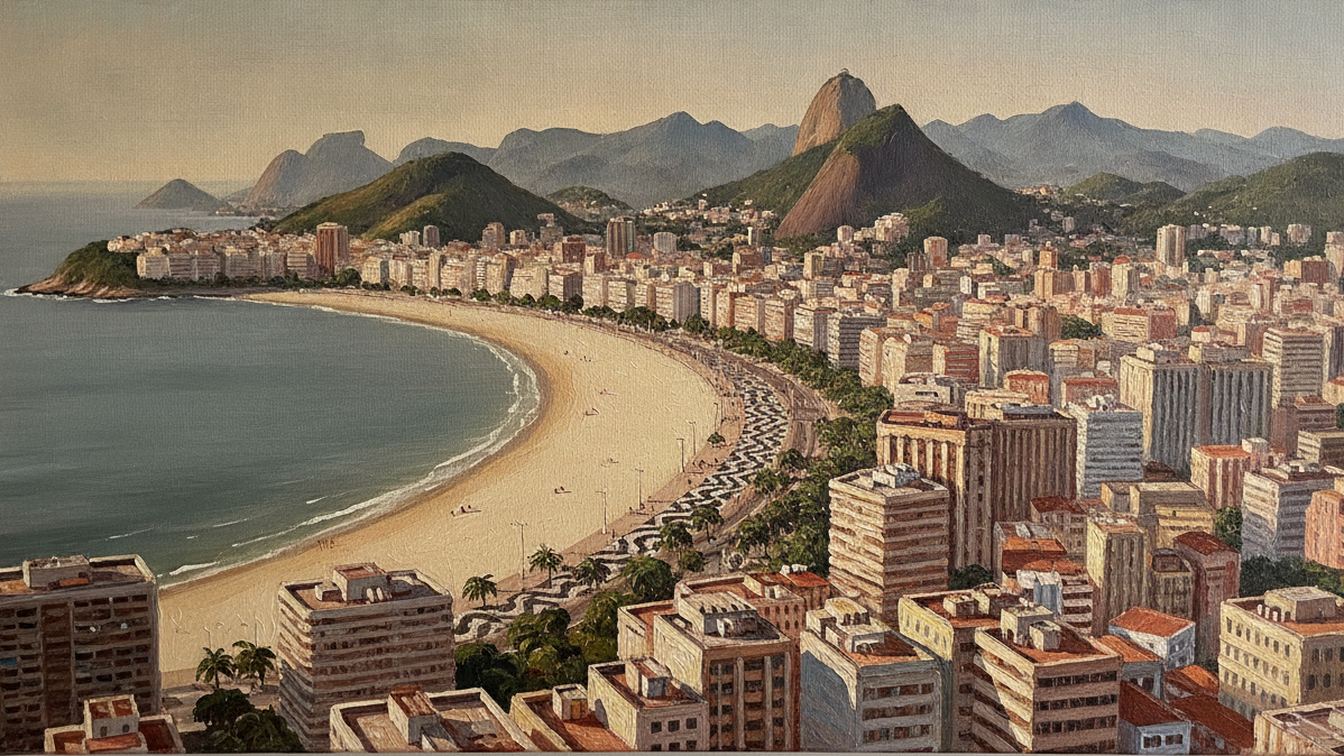
Painted illustration of the Copacabana neighborhood of Rio de Janeiro from above in late afternoon: the long crescent of beach and the wave-pattern promenade curving below, backed by a dense mass of apartment buildings running inland toward green hills.
Map of Copacabana, Rio de Janeiro, showing Avenida Atlântica along the full crescent of the beach, the metro line inland, Leme to the north and Arpoador to the south.
Copacabana, Leme and Arpoador. Map data © OpenStreetMap contributors.

Why Copacabana gets such contradictory reviews

Because a neighborhood this long cannot have one character. Copacabana is one of the most densely populated bairros (neighborhoods) in Rio — well over a hundred thousand people in a strip about three kilometers long and a handful of blocks deep — one of the densest neighborhoods in the country — and that kind of density produces variety rather than uniformity. Leme, the small bairro tucked behind its own headland at the north end, is quieter by a wide margin and behaves like a separate town, because in municipal terms it is one.

One figure explains the place better than the density does: about one Copacabana dwelling in four is not anybody’s year-round address. Short-term rentals, empty apartments, pieds-à-terre, inherited units tied up in probate. That is the whole neighborhood in a sentence — simultaneously deeply lived-in, full of people who have been here fifty years, and constantly cycling strangers through the lobby. The resident population has been slowly shrinking for years while the churn has grown, and both halves of that are visible from any street corner.

The three streets that organize everything

Copacabana is a strip, not a square, and three parallel roads run its whole length. Understanding them is most of the work.

  • Avenida Atlântica — the beachfront. Hotels, the mosaic promenade, the kiosks. Beautiful, and loud until late. Every room facing it trades quiet for the view.
  • Avenida Nossa Senhora de Copacabana — one block back, the neighborhood’s main commercial street. Pharmacies, banks, juice counters, bakeries, and buses nose to tail. Functional, not pretty, and the reason people who live here never need a car.
  • Rua Barata Ribeiro — two blocks back, the traffic artery and the residents’ street. Supermarkets, botequins (old-school corner bars), the metro stations, and most of the food worth crossing town for.

Behind those sit the calm cross-streets — Domingos Ferreira, Aires Saldanha, Toneleros — and behind those, the hills. Ladeira dos Tabajaras and Morro dos Cabritos rise directly behind the middle of the neighborhood; Pavão-Pavãozinho and Cantagalo sit on the ridge between Copacabana and Ipanema; Babilônia and Chapéu Mangueira look down over Leme. They are communities with their own streets, shops and history, and they are part of this neighborhood’s shape whether a guidebook says so or not. Several have a real visitor economy — guided walks, viewpoints, bars — so you can go if you want to, at your own risk, with a guide who genuinely knows the community. The honest version of that decision is in our Rio safety guide. What is true either way: walking past one of these hillsides is not an event, and nobody who lives here treats it as one.

The operating rule: in Copacabana one block matters more than one kilometer does in most cities. Book the block, not the neighborhood.

Copacabana stretch by stretch: which part should you actually book?

The beach is divided by lifeguard posts — postos — numbered 1 at the Leme end through 6 at the fort, and cariocas (Rio locals) give directions by them. Learn the six and you can read every hotel listing in the neighborhood.

Stretch Character Nearest metro Our verdict
Leme (Posto 1) Residential, calm, wide sand, families, quiet after 10pm Cardeal Arcoverde (10–15 min walk) Best for families and repeat visitors
Posto 2 — Prado Júnior Loud, awake all night, hostels and cheap hotels, visible late-night street scene Cardeal Arcoverde Do not book your first Rio hotel here
Posto 3 — the Palace block The postcard: widest beach, grand hotels, doormen, best-kept promenade Cardeal Arcoverde / Siqueira Campos Safest booking if the budget clears it
Posto 4 — the middle Maximum everyday Copacabana: pharmacies, supermarkets, crowds, noise Siqueira Campos Best value per minute of walking; worst noise
Posto 5–6 — the fort end Quieter, more residential, narrower beach, walkable to Ipanema Cantagalo Book here — the right answer for most visitors

Leme (Posto 1) — the quiet corner

Leme is a separate bairro, cut off from Copacabana by the divided lanes of Avenida Princesa Isabel, and it behaves like one. About a kilometer of beach, wider and calmer at the top end, more grandparents and toddlers than volleyball. The buildings are lower, the sidewalks emptier, and the whole thing dead-ends against the Pedra do Leme.

That dead end is the best hour in the neighborhood. The Caminho dos Pescadores Ted Boy Marino runs around the base of the rock to a fishing point, and a paved path climbs from Praça Almirante Júlio de Noronha to the Forte Duque de Caxias — locally, the Forte do Leme — in fifteen to twenty-five minutes of steady uphill. From the top you get the entire arc of Copacabana laid out below. It is a working Army installation, and it publishes its terms: Tuesday to Sunday, 9:30am to 4pm, R$10 full and R$5 half, free on Tuesdays outside holiday weeks. Bring cash or Pix — cards are not accepted — and note the posted rules, which turn people away at the gate: no swimwear, no drones, no pets, no coolers or beach chairs.

The trade-off is real: no metro station, a thin restaurant scene, and nothing much open late. The Hilton Rio de Janeiro Copacabana carries Copacabana in its name but sits on the Leme side of the boundary, at what is genuinely the widest and best-looking part of the whole beach. Book Leme if you have children with you or you have done Rio before; skip it if you want to walk to dinner.

Posto 2 and Avenida Prado Júnior — where the reputation comes from

Cross Princesa Isabel and the temperature changes within a block. The stretch around Avenida Prado Júnior and Rua Duvivier is the Copacabana of the internet’s imagination: bars that do not close, hostels, cheap beachfront hotels, a visible sex-work scene along Avenida Atlântica after dark, and heavy foot traffic at three in the morning. It is not dangerous the way forum posts suggest. It is awake, and anywhere awake at 4am collects opportunists.

It also has the one address in this part of the neighborhood worth crossing town for. Cervantes — Avenida Prado Júnior 335, open daily from late morning until the early hours — has been going since the 1950s, and the roast-pork-and-pineapple sandwich is the reason. It closed for a spell and reopened under the Boteco Belmonte group, counter and late hours intact. Regulars eat it standing at the counter on the Barata Ribeiro side at two in the morning, which is the only way the place fully makes sense.

Our verdict: come here to eat. Do not put a first-time visitor’s suitcase here — the noise is relentless and the arrival impression is the worst Copacabana gives.

Posto 3 — the Copacabana Palace block

Around Rua Rodolfo Dantas and the blocks either side of it, Copacabana straightens its tie. The Copacabana Palace has stood at Avenida Atlântica 1702 since 1923 — a French-designed grand hotel, run today by Belmond — and the block has organized itself around it ever since. If you are booking it, know what is shut: the spa, the Cipriani restaurant and the annex are closed for renovation, and the main pool is being rebuilt with a smaller sixth-floor pool standing in. Mee and the Pérgula are open, and the annex is due back at the end of 2026. Wide beach, well-maintained promenade, and the particular calm that comes from a street with a lot of doormen on it.

It is not just heritage. The hotel’s pan-Asian dining room, Mee, holds a MICHELIN star in the current Rio and São Paulo selection — the fine-dining high point of the neighborhood by a distance. Book it weeks out, and check what else in the hotel is open on your dates, because the Palace runs a long renovation program and rooms and restaurants come in and out of service.

Our verdict: the least risky booking in Copacabana, and you pay for that. If the rate makes you wince, the Posto 5–6 end buys a quieter night for less.

Posto 4 — the working middle

Rua Santa Clara, Rua Figueiredo de Magalhães, Siqueira Campos metro. This is the most Copacabana part of Copacabana and it is not remotely glamorous: a pharmacy on nearly every block, the big supermarkets, a rush-hour crush on Nossa Senhora de Copacabana that has to be walked to be believed, and storefronts that turn over constantly.

It is also where the eating is. Adega Pérola, Rua Siqueira Campos 138A, has been running since the late 1950s — a Portuguese-style counter with dozens of dishes of conservas and petiscos (preserved seafood and small bar plates) behind glass, ordered by pointing at what you want, which is a good part of the appeal. Pavão Azul, Rua Hilário de Gouveia 71, is two blocks back from the sand and changes character through the day: a proper lunch kitchen — the shrimp risotto is the dish it is known for, with feijoada (the national black-bean and pork stew), oxtail and cod omelet on the same menu — turning into a petiscos-and-cold-beer bar in the evening. Both are better than anything on the beachfront within a kilometer.

Our verdict: the best value in Copacabana if you will accept traffic noise, and the stretch where staying two streets back rather than on the sand actually improves the trip.

Posto 5 to Posto 6 — the end to book

From roughly Rua Bolívar down to Rua Francisco Otaviano, Copacabana calms down. The beach narrows, the crowd thins, and the buildings shift from hotel to apartment. Rua Aires Saldanha and Rua Domingos Ferreira are quiet enough to sleep on — quiet being exactly the point by day, though like every side street in this neighborhood they empty out after midnight, so come home late along the avenues or by car rather than through the back blocks. Cantagalo metro is here. Ipanema is a ten-minute walk over Francisco Otaviano and the Arpoador rocks about fifteen — meaning you get Copacabana prices with Ipanema access, which is the single best arbitrage in Rio hotel booking.

The point is closed by the Forte de Copacabana, the army fort turned museum at Praça Coronel Eugênio Franco 1. It was built in 1914 and opens Tuesday to Sunday, 10am to 7pm, closed Mondays. Entry is R$10, half price R$5 — and the fort takes cash or Pix only, no cards, which strands more visitors than anything else here. Tuesdays are free, but only for followers of the fort’s Instagram account and not on public holidays, so do not count on it.

The reason to go is not the artillery. It is that the fort occupies the headland, so walking out to the sea wall gives you the entire beach in one frame — the only place you get that view at ground level. Inside sits the Café do Forte, the Confeitaria Colombo outpost, open Tuesday to Sunday 10am to 7pm — the same hours as the fort — and closed Mondays, with the arc of Copacabana filling the window. It is the one view-priced meal in this neighborhood we rate as worth it.

The Emiliano Rio anchors the luxury end of this stretch. Elsewhere on these blocks the buildings are ordinary, the rates are noticeably softer than Ipanema’s, and nobody is trying to sell you anything on the sidewalk. For most visitors on most trips, this is the stretch to book.

What Copacabana is genuinely good at

The beach before nine in the morning

This is the thing visitors miss most. Between six and nine the calçadão (the beachfront promenade) belongs to the neighborhood: swimmers, walkers, the older Copacabana out in force, the sand raked, the kiosks still setting up. By eleven it is a different and much busier place. If you take one piece of advice from this guide, make it an early alarm.

Note the orientation while you are out there. Copacabana’s arc opens south and east, so the sun tracks across the water through the morning and drops behind the buildings in the evening. Copacabana is not a sunset beach. That is why the sunset crowd in this part of Rio is always on the rocks at Arpoador, ten minutes’ walk past the fort — and why “sunset drinks on Copacabana beach” is a promise no bar here can actually keep. Go for the sun and come back with it: the rocks are packed and lovely while it drops, but once the crowd thins, that headland is not a place to linger after dark with a phone out.

Sunday morning, when the road closes

On Sundays and public holidays the beachfront lane of Avenida Atlântica shuts to traffic for the city’s área de lazer (leisure zone), along the stretch between Rua Francisco Otaviano and Avenida Prado Júnior, normally from 7am to 6pm — later in summer. Runners, cyclists, skaters, strollers, and an entire city walking slowly. The window moves — the city traffic authority brings the closure forward or extends it whenever something is happening on the sand, and publishes the change a day or two ahead — so check the day’s notice rather than a fixed time. Walk it end to end. Nothing else shows you the whole neighborhood at once.

The sidewalk, which is a real piece of design

The black-and-white wave underfoot is Portuguese calçada (mosaic paving) work — hand-set stone, piece by piece, relaid by the city as fast as it lifts. What you are walking on is not decoration bolted onto a road. It is a designed landscape: the wave pattern dates to 1906, and Roberto Burle Marx’s 1970 redesign turned it to run along the sea, extended it across the reclaimed land and laid out the planting and the building-side sidewalk. UNESCO named that work — alongside his Flamengo Park — when it inscribed Rio’s carioca landscapes as World Heritage. Almost nobody looks down, and it is the best free thing in the neighborhood.

Botequim culture, which Ipanema mostly lost

Copacabana still has the tiled, fluorescent-lit, standing-room bars that made carioca eating what it is — Adega Pérola, Pavão Azul, Cervantes and a dozen more that never make an English-language list. Ipanema and Leblon have better restaurants; Copacabana has better bars, and the gap is not close. Rents that never fully gentrified are the reason, and a visitor gets the benefit.

What we would skip in Copacabana

  • The all-you-can-eat churrascarias (grilled-meat houses) on Avenida Atlântica with laminated photo menus and someone outside waving you in. The pricing assumes you are never coming back, and it is right.
  • Beachfront restaurant terraces between Postos 2 and 4 as a general category. You pay a view premium for food that a botequim two streets back does better and cheaper. The exception is a cold beer at a kiosk, which is exactly what a kiosk is for.
  • Anything sold off a tray on the promenade — the “silver” jewelry, the sunglasses, the hats. Not a scam so much as a waste of a negotiation.
  • Waiting on Copacabana for a sunset. Wrong beach. Walk to Arpoador.
  • Chairs and umbrellas without asking the price first. Nothing is posted, and rates vary from one barraca (beach stand) to the next, and from a quiet Tuesday to a peak-summer weekend. Ask before you sit down; it is a completely normal question.

Is Copacabana safe?

Better than its reputation, which is years out of date. Copacabana is big, loud and more mixed than Ipanema or Leblon — 24-hour life on the beachfront, side streets that empty fast after midnight — and none of that is the same thing as dangerous. Violent street robbery here has fallen steeply — down by well over half since its peak, on the state’s own figures — and the neighborhood now reads much like its calmer neighbors. What has not fallen with it is opportunistic theft, and that is the honest shape of the risk: the thing most likely to happen to you in Copacabana is losing a phone off a café table or out of a beach bag, not being confronted by anyone. Habits matter far more here than the block number does.

The practical version: carry what fits in one hand to the beach, keep the phone in a pocket rather than on the table, use the lit promenade or a car after dark instead of the sand, and take an Uber late at night — they are cheap and universal. The nights worth planning differently are the mass-crowd ones, when this beach stops being a beach and becomes a stadium: Réveillon (New Year’s Eve) and the free concerts that put a million-plus people on the sand are when phones vanish in volume. Travel insurance that genuinely covers phones and cameras earns its keep in this specific neighborhood.

For the block-by-block version of this question, the practical rules, and what to do if something does happen, see our Copacabana safety guide; for the citywide picture, our Rio safety guide.

Can you swim at Copacabana?

Usually, yes — with two checks. Rio state’s environment institute, INEA, samples the water along every monitored beach in the state and publishes a balneabilidade (bathing-water quality) bulletin every week, classifying each point as própria or imprópria — suitable or unsuitable for swimming. Copacabana and Leme are both sampled, and both pass most of the time. What flips a reading is rain, and INEA’s standing advice is blunt: avoid the sea for 24 hours after heavier rainfall, and stay away from the mouths of storm drains and canals. Check the current bulletin before you swim — it is the week’s actual answer, not a guess.

The second check is the water itself. Copacabana takes open ocean swell and the shore break is genuinely powerful, with a steep drop and strong pull along the beach in places. Lifeguards are stationed at each posto. Swim in front of them, not in an empty stretch, and treat the Leme end as the calmer option.

Who should stay in Copacabana — and who should not

Copacabana suits you if you want to be inside a real neighborhood rather than beside one — pharmacies open late, a supermarket on the corner, buses and metro at the door, people who live here going about a Tuesday. It suits first-timers who want the famous beach, families who take Leme, anyone who wants a beachfront room for meaningfully less than Ipanema or Leblon charges, and anyone coming for Réveillon, which happens here and nowhere else.

Stay somewhere else if you sleep lightly and were planning a room on Avenida Atlântica or Nossa Senhora de Copacabana — the traffic does not stop. If your picture of Rio is calm and moneyed, that is Leblon. If you want the best walkable dinner range in the city, that is Ipanema. And if crowds are the thing you cannot tolerate, January to March on this beach will test you — see when to visit Rio before you commit. The full comparison across every Zona Sul (South Zone) neighborhood lives in where to stay in Rio.

Where to stay in Copacabana

Rate-shop the stretch before the property. A four-star at Posto 5 will out-perform a five-star at Posto 2 on everything except the lobby. Three anchors, one per band — the wider shortlist sits in the best luxury hotels in Rio, and rooms with a fireworks view are their own problem, handled in the Réveillon hotel guide.

Some rate links on this page will become affiliate links once our booking partnerships go live. We are paid nothing to include a hotel, and no property here has any say in what we write about it.

Copacabana Palace, A Belmond Hotel

Avenida Atlântica 1702, Posto 3. Open since 1923, run by Belmond, and home to Mee, which holds a MICHELIN star in the current selection.

Emiliano Rio

On Avenida Atlântica at the quiet southern end of the beach. Contemporary design hotel on the stretch that walks to Ipanema in ten minutes.

Hilton Rio de Janeiro Copacabana

On Avenida Atlântica, over the line in Leme, facing the widest sand on the beach. The reliable big-box option, and the calmest end of the strip.

Two booking rules for this neighborhood specifically. First, a “sea view” here can mean a 30-degree sliver past a neighboring tower — read the room description, not the hotel description. Second, rear-facing rooms are usually the better night’s sleep and often cheaper; on this beach the view is thirty seconds away in the elevator, and you are not going to spend the evening looking at it anyway.

Getting around from a Copacabana base

Three metro stations sit inside the neighborhood, which is the main reason a Copacabana base works without a car. Line 1 stops at Cardeal Arcoverde (Posto 2, Leme end), Siqueira Campos (Posto 4, the middle) and Cantagalo (Posto 5–6, the fort end), with General Osório in Ipanema one stop further and walkable from the south end. Leblon has two stations of its own on Line 4, Jardim de Alah and Antero de Quental, so the metro argument is a Copacabana edge rather than a Copacabana monopoly.

  • Fare: R$7.90 for a single journey at last check — the official tariff page is the place to confirm it. Contactless credit and debit cards work at the gates, foreign-issued ones included, so no ticket is needed.
  • Hours: Monday to Saturday 5am to midnight; Sundays and holidays 7am to 11pm.
  • On foot: the promenade runs about four kilometers end to end — call it fifty minutes at a walking pace, and there is no better orientation exercise on your first morning.
  • Uber: universal, inexpensive, and the default after dark. Santos Dumont is the closer of the two airports; for Galeão arrivals a pre-booked transfer removes the one moment of the trip where jet lag and a new city overlap.

Christ the Redeemer and Sugarloaf are both straightforward from here — the logistics, the right time slot and which access route to use are in our Christ the Redeemer guide.

Quick answers

Is Copacabana a good place to stay in Rio?

Yes, if you pick the stretch deliberately. The Posto 5–6 end near the fort and Leme at the far north are calm, well-connected and cheaper than Ipanema; the blocks around Avenida Prado Júnior are loud and are where most bad reviews originate.

Is Copacabana safe at night?

Yes, with the habits that apply anywhere in Rio. The main streets are busy and policed, and violent street robbery here has fallen steeply in recent years; what has not fallen is opportunistic theft, so the practical risk is your phone. Stay on the lit promenade or the main avenues, do not cross the sand after dark, and take an Uber late.

Copacabana or Ipanema — which is better?

Ipanema has the better restaurants, the calmer beach and the higher rates. Copacabana has the better bars, the metro, the bigger hotels and more room for the money. Split the difference by booking the Posto 5–6 end of Copacabana, which walks to Ipanema in ten minutes.

Which posto is best on Copacabana beach?

Posto 1 in Leme for the widest, calmest sand and families. Posto 3 for the classic scene in front of the Copacabana Palace. Posto 6 by the fort for the quietest crowd and the walk to Arpoador. Postos 2 and 4 are the busiest and the loudest.

How many days do you need in Copacabana?

As a base, the whole trip — it is central and well connected. As a sightseeing target, half a day: the fort and Café do Forte, the promenade walk, and an early morning on the sand covers it.

Practical details

  • Forte de Copacabana (Museu Histórico do Exército e Forte de Copacabana) — Praça Coronel Eugênio Franco 1, Posto 6. Tuesday to Sunday, 10am–7pm, closed Mondays. R$10, half price R$5; cash or Pix only, no cards. Free Tuesdays for the fort’s Instagram followers, holidays excepted. Nearest metro Cantagalo, or General Osório — both about 15–20 minutes on foot.
  • Café do Forte (Confeitaria Colombo) — inside the fort, Praça Cel. Eugênio Franco 1, Posto 6. Tuesday to Sunday, 10am–7pm; closed Mondays. Note that fort entry is cash or Pix only. Roughly 15–20 minutes on foot along the seafront from Cantagalo or General Osório.
  • Forte Duque de Caxias (Forte do Leme) — access from Praça Almirante Júlio de Noronha at the end of Leme beach; fifteen to twenty-five minutes uphill on a paved path. Opening hours and entry fee are not reliably published. Check at the gate.
  • Cervantes — Avenida Prado Júnior 335, counter on the Rua Barata Ribeiro side. Daily, 11am to 5am.
  • Adega Pérola — Rua Siqueira Campos 138A. Trading since the late 1950s; conservas and petiscos chosen from the counter.
  • Pavão Azul — Rua Hilário de Gouveia 71, two blocks back from the beach. Lunch dishes, then petiscos and beer in the evening. Hours are not published by any source we trust — expect a crowd and expect to stand.
  • Mee — inside the Copacabana Palace, Avenida Atlântica 1702. Holds a MICHELIN star in the current Rio and São Paulo selection. The restaurant handles its own bookings; book ahead.
  • Metro — Cardeal Arcoverde, Siqueira Campos, Cantagalo (Line 1). R$7.90 single; Mon–Sat 5am–midnight, Sun and holidays 7am–11pm.
  • Sunday leisure closure — beachfront lane of Avenida Atlântica on Sundays and public holidays, between Rua Francisco Otaviano and Avenida Prado Júnior, normally 7am–6pm (later under summer time). The window shifts for events; CET-Rio posts the change at prefeitura.rio.
  • Bathing water — INEA publishes a balneabilidade bulletin every week, Copacabana and Leme among the beaches it samples. Its standing advice is to stay out of the sea for 24 hours after heavier rain, and away from storm-drain outfalls.

Prices, hours and opening days in Rio change without notice. Everything on this page is verified on a standing cycle. Nothing here is a paid placement; we take no payment for inclusion.