Réveillon in Copacabana: The Complete Guide

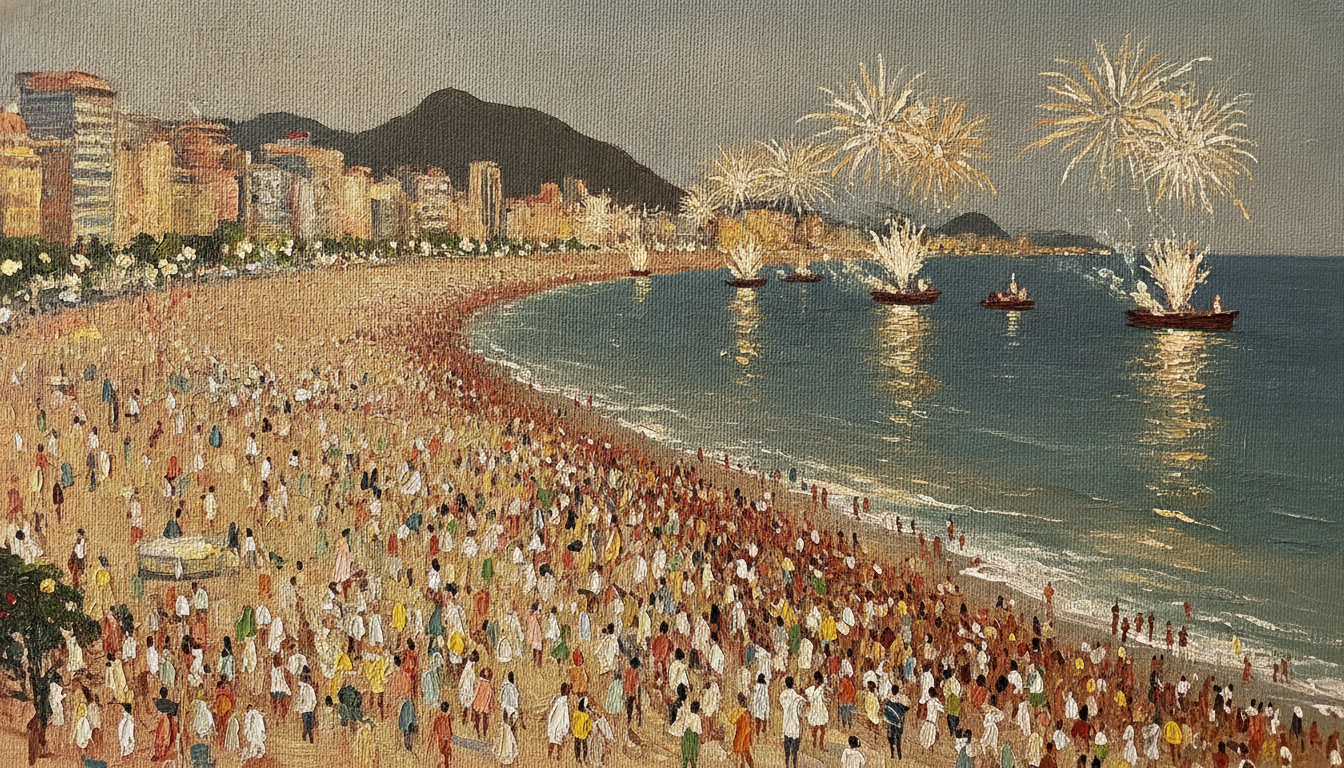
Painted illustration of New Year's Eve on Copacabana beach: an enormous crowd dressed in white filling the sand along the curve of the bay, facing fireworks bursting over barges anchored offshore.
Map of Copacabana, Rio de Janeiro, showing Avenida Atlântica along the full crescent of the beach, the metro line inland, Leme to the north and Arpoador to the south.
Copacabana, Leme and Arpoador. Map data © OpenStreetMap contributors.

Checked 4 August 2026. Nothing has been published yet for 31 December 2026 — no lineup, no stage plan, no traffic or metro scheme. What follows is the shape the night has taken in recent editions, and it is a stable shape. The headline names start landing around mid-November; the full stage-by-stage program follows about 19 December; MetrôRio opens passport sales around the 15th; and the city presents its operational plan — road closures, metro times, medical posts — at the operations center on about 26 December, with the state security scheme at the same time. Both reveillon.rio and metrorio.com.br/reveillon stay live year-round but carry the previous edition until the new plan lands, so check the date on anything you read there.

What actually happens on Copacabana on New Year’s Eve?

Avenida Atlântica closes to traffic at 7am on the 31st — the city has been moving that closure earlier year on year — and the beach fills all day. By late afternoon the sand is a single white crowd from Leme to the fort, four kilometers end to end. In recent editions three stages have played — the main one in front of the Copacabana Palace, a samba stage a few hundred meters south of it, and a gospel stage up in Leme. The Leme stage has come and gone, so treat the configuration as something the city confirms each year. All three sit in the northernmost kilometer or so of a four-kilometer beach, which is why everything from Posto 3 south has no stage at all. At midnight the sky opens: twelve minutes of fireworks in recent years, fired from barges anchored the whole length of the shoreline, so nobody has a bad seat. Then the headline acts come back on, the samba schools close it out around 3.30am, and the crowd walks home through streets that will not see a car until 5am.

The scale is what first-timers underestimate. Copacabana alone takes a crowd in the millions, with millions more spread across the stages the city puts up in other neighborhoods, and Guinness World Records recognized it in December 2025 as the largest New Year’s Eve celebration staged by a city — 2.5 million people on the sand on 31 December 2024, counted from drone imagery. Rio runs it like a civil-defense exercise — closed roads, staffed medical posts on the sand, an operations center watching the whole beachfront — which is the reason a crowd that size moves as calmly as it does.

Two things follow, and they are the ones to hold on to. First: it is free. There is no ticket to Réveillon, no VIP sand, no upgrade — the paid parties are all indoors or on balconies, looking down at the free event. Second: a crowd this size behaves like weather. You do not move through it quickly, you do not change your mind about where you are standing at 11.45pm, and you do not get a phone signal when it matters.

What time does everything happen?

The music changes every year; the clock does not. This is the operational skeleton, and it repeats.

Time What happens What it means for you
7am, 31 Dec Avenida Atlântica shuts completely, along with the Ipanema and Leblon beachfront avenues Your hotel is now reachable on foot only from behind. Get luggage in before this.
Through the morning Search points go up on every street feeding the beach, with metal detectors and bag checks Everything you carry gets looked at. Travel light.
6pm Stages open; the beach is already dense in front of the Copacabana Palace If you want a specific spot, you are already too late by about two hours.
7pm Private cars barred from Copacabana — regular buses and licensed taxis only. Metro switches to its Réveillon operation. If you are being driven, it has to be a taxi from here, and only until 9pm.
8pm First headline set on the main stage The good hour to arrive if you want atmosphere without the midnight crush.
9pm Complete vehicle blockade — nothing on wheels enters Copacabana Hard cutoff. After this it is your legs or nothing.
Midnight Twelve minutes of fireworks from barges strung the whole length of the beach Face the sea. Do not try to move.
12.12am Midnight acts take the stages the moment the last shell fades The crowd thins fast here. This is the smart exit window.
2am Second headline slot on the main stage The night’s other peak, with a fraction of the midnight crowd.
3.30am Samba schools close both main stages The best free samba of the year, if you have the legs.
5am, 1 Jan Metro Réveillon operation ends; the roads into Copacabana reopen, but Avenida Atlântica itself stays shut Miss this and you are walking or waiting until the regular service returns at 7am. The beachfront lane is not back until early evening.

One scheduling quirk worth knowing: the biggest act of the night does not go on at midnight. In recent editions the city has given the fireworks their full run uninterrupted, then restarted the music a few minutes past twelve with one of the night’s headline names. If your plan is “fireworks then leave”, you are leaving into the thickest part of the night — better to hold position for twenty minutes and let the first wave go.

The city has taken to putting a big aerial set-piece over the water — 1,200 drones flying with the closing DJ set at the most recent turn, a laser ballet the year before that, drones at the countdown the year before that. It is announced with the rest of the program and it changes shape every year, so treat it as a bonus rather than a plan.

Where should you stand? Posto by posto

Copacabana has three metro stations, all on Line 1: Cardeal Arcoverde at the Leme end, Siqueira Campos mid-beach and busiest, and Cantagalo at the Ipanema end. Cariocas (Rio locals) navigate Copacabana by postos — the numbered lifeguard stations, counted from the Leme end down toward the fort. Avenida Atlântica runs a little over four kilometers from Praça Almirante Júlio de Noronha in Leme to Praça Coronel Eugênio Franco at Posto 6, where it stops. Every local address, meeting point and taxi instruction on that beach uses the numbers, so learn them before you arrive.

Here is the part almost every guide gets wrong. The barges are strung along the entire shoreline, which means the fireworks are excellent from anywhere on the sand. What changes from one end to the other is not the view — it is density, noise, and how bad the walk out is. Choose on those.

Stretch What it is like Our verdict
Leme — the far north end The quiet end, under the Morro do Leme. Its own stage at Rua Anchieta facing the Forte do Leme, gospel programming in recent editions. Families, older cariocas, room to sit. The pick for a first Réveillon. Same fireworks, a fraction of the crush, and you can still hear yourself.
In front of the Copacabana Palace The main stage sits directly in front of the hotel. The densest sand on the beach from mid-afternoon. Go if the lineup is the point. Otherwise skip it — you will spend the night pinned and you will not get out quickly.
Mid-beach The classic postcard angle, with the curve of the bay on both sides. South of all three stages, so the sound arrives at a comfortable distance. The best compromise, and where we would point most visitors who want the full spectacle.
The fort end, around Posto 6 No stage down here at all — the nearest is more than two kilometers north. Emptier sand, the fireworks in full, and the Forte de Copacabana at your back. The strategist’s choice. Good sand, the quietest crowd on the beach, and when you have had enough you can walk round Arpoador into Ipanema and the General Osório metro.

Two things about position. Stand well up the sand, not at the waterline: on a big-swell New Year the water pushes right up to where the stages are built, and the front rank on a night like that is where people get into trouble. And pick your exit before you pick your spot — the walk out is far more painful than the walk in, because the whole beach starts it at roughly the same moment.

Why does everyone wear white — and what are the seven waves?

Wear white. Not as a costume — because everyone does, and arriving in black is the one thing that marks you out instantly.

The tradition is religious in origin and Brazilian to the bone. Iemanjá is a female orixá — a deity in the Yoruba-rooted faiths of Brazil — and a protective mother of the sea in both Umbanda and Candomblé (Afro-Brazilian religions). The coast fills at the turn of the year with people thanking her: flowers, candles, food, small boats pushed out into the water. The gathering on that particular beach on that particular night was driven from the 1950s by Tancredo da Silva Pinto — known as Tata Tancredo, the leading priest of Umbanda Omolokô in Brazil and a sambista (samba musician and composer), who founded one of the first national Umbanda federations around 1950 and helped set up others across the country, explicitly to give terreiros legal cover during a period of police repression. People came to the sand dressed in white, made their offerings, jumped seven small waves and asked for a prosperous year. The historian Luiz Antonio Simas calls him the great driving force behind the Umbanda occupation of Rio’s beaches on the night of 31 December.

The fireworks came later, and they came from commerce: the first collective display was in 1978, paid for by Leme and Copacabana merchants at the urging of the owner of the By Marius churrascaria (steakhouse). From the following year the old Hotel Le Méridien — now the Hilton — poured a cascade of fireworks down its thirty-nine storeys as the finale, and the spiritual gathering was gradually rebuilt around a hotel-and-tourism spectacle. The babalawô (Ifá priest) and historian Ivanir dos Santos and Simas both describe the same drift: as the megashows took over, terreiros (Afro-Brazilian houses of worship) moved their ceremonies to other places and other dates rather than compete with a stadium PA.

Which is why the observance you are most likely to see is not on the 31st at all. The Festa de Iemanjá do Mercadão de Madureira, a carioca cultural heritage listing, processes from Madureira on 29 December and gathers on Copacabana at Posto 4, where boats of offerings are pushed out to sea. It is currently the largest religious procession heading to that beach. If you are in Rio on the 29th, that is where the tradition actually lives. Wherever you meet it, the etiquette is the same: do not stand in an offering, do not photograph faces without asking, and do not treat a terreiro’s ceremony as an attraction.

How do you get in and out? The part everyone gets wrong

Here is the single most expensive mistake in Réveillon planning: assuming you can take a car. You cannot. Private vehicles are barred from Copacabana from 7pm, and from 9pm nothing on wheels enters at all. Avenida Atlântica itself has been closed since 7am. Uber and 99 (Brazil’s other ride-hailing app) simply cannot reach you, and they cannot collect you afterwards either — the roads do not reopen until 5am on 1 January, and the beachfront lane stays shut until early that evening.

The metro is the answer, and it needs buying in advance

MetrôRio runs a dedicated Réveillon operation from 7pm on 31 December to 5am on 1 January, and it does not accept normal fares. You buy a Réveillon passport — a round trip, around R$15, about US$3 — as a QR code in the app or on the website, choosing one of five hourly departure bands between 7pm and midnight. Online sales close at 6pm on 31 December, or earlier if they sell out. Ten per purchase, non-refundable.

The detail that caught people out last New Year was the wristband, introduced for that edition and likely to repeat. When you tap through the gate on the way in, you are handed a wristband, and without it there is no return journey — and if you walked to the beach rather than taking the metro in, you have to collect one in advance. Last edition that meant between 2pm and 10pm on 31 December, at Siqueira Campos, Cantagalo, General Osório, Jardim Oceânico or Maracanã. Confirm it on the metro page in December: getting this wrong at 3am, four kilometers from anywhere, with no cars running, is a genuinely bad night.

Station rules for the return, from midnight to 5am: boarding is only at Cardeal Arcoverde, Siqueira Campos and Cantagalo (all Copacabana), General Osório (Ipanema) and Jardim Oceânico (Barra), plus, at the last edition, Maracanã until 2am. Every other station is exit-only, and Cardeal Arcoverde is exit-only from 7pm until midnight. MetrôRio itself points people at Siqueira Campos in both directions, and that is the right call — it sits mid-beach and has the best circulation. You also cannot bring large volumes over 25 liters onto the metro — cool boxes, styrofoam boxes, ice bags — nor glass bottles, boards, bicycles or fireworks, and you will not be let on barefoot, shirtless or in swimwear.

If you are not taking the metro

Buses run a special scheme, with Terminal Enseada de Botafogo as the hub from 9pm to 5am and a couple of dozen municipal lines rerouted along Avenida Nossa Senhora de Copacabana and Avenida Prado Júnior between 6pm and 9pm. On the trains, Central do Brasil closes around 9.15pm and reopens around 12.20am.

Our recommendation is simpler: walk out. From Posto 6 it is a flat walk round Arpoador into Ipanema and General Osório; from Leme it is a short walk round into Botafogo. Both routes bypass the worst of the station queues, and both are busy with people doing exactly the same thing until well past 3am. Agree a meeting point with your group before you go anywhere near the sand — a named street corner behind the beach, not “by the stage” — because the mobile network will not hold up.

If you are flying in on 30 or 31 December, book a transfer rather than improvising at the airport. Access to Copacabana degrades through the 31st, and a driver who knows which streets are still open on the day is worth the money.

Is Copacabana safe on New Year’s Eve?

Yes, with the usual Rio street sense and one genuine hazard that has nothing to do with crime. On this one night Copacabana is the most closely watched stretch of ground in Rio — a security belt with search points on every pedestrian route to the sand, metal detectors and facial-recognition cameras at those points, observation towers along the beachfront, municipal teams working the sand, and an operations center running the whole thing live. Expect to be looked at on the way in, and travel light. Setting off your own fireworks is illegal across Rio, not just on this beach — a city law bans private use outright and leaves the display to the city — and street vendors may not sell glass bottles, so take drinks in plastic or buy them on the sand.

The realistic risk is the same as any night in Copacabana, concentrated: phone snatching. Municipal guards walked one person off that beach last New Year carrying twenty-nine phones, wrapped in foil inside false-bottomed bags — an operator taking them off-network, not an opportunist. Five of the owners were foreign visitors, and the case went to the city’s tourist police station. The formula for this specific night is the one in our safety guide: agree a physical meeting point, carry cash in two places, take a phone you would survive losing, and book a room you can walk back to. Keep the phone in a zipped front pocket, take it out only with your back to something, and leave the watch and the jewelry in the safe. Our fuller treatment is in is Copacabana safe? and our Rio safety guide.

The hazard the guides leave out — and the authorities shout about — is the sea. Copacabana and Leme are open Atlantic beaches, and on a New Year with a ressaca (heavy swell) running, the fire brigade pulls hundreds of people out of the water between the evening of the 31st and dawn — many times what it handles on a calm turn. The causes are the ones you would guess: extreme heat, and bathers ignoring the flags and the whistles. On a bad-swell year the lifeguards tell people not to do the seven waves at all, and they mean it. Nobody prohibits it. There is no ban on entering the water at any point on the night; what happens instead is that every authority that can warn you does — red flags at the lifeguard posts, a Navy swell warning, a Civil Defence alert pushed to phones. The one thing that is formally closed is the water around the fireworks barges, which the Navy interdicts from early evening until the small hours. Children get separated from their families on that beach every year, too; municipal guards hand out waterproof ID wristbands for children at the access barriers, and you should take one — it carries the child’s name and a guardian’s phone number, so have a working local number to put on it. Jump your seven waves at the very edge, in daylight if you can, and do not swim after dark. This is the one line in this guide we would not soften.

Practical care: in each of the last two editions the city has run four municipal medical posts along Avenida Atlântica from 5.30pm until 5am — at Avenida Princesa Isabel, Praça do Lido, Rua República do Peru and Rua Siqueira Campos. Travel insurance that covers a crowd injury and a missed onward flight is worth having for this specific night.

What does Réveillon cost?

The party itself costs nothing. The night around it is where Rio charges you, and it charges hard. The prices below are from the 31 December 2025 edition, the most recent published. No Copacabana venue has released pricing for this coming New Year yet — venue announcements cluster from late October to late November, and tickets sell in escalating batches: one rooftop went R$2,000 to R$2,800 to R$3,200 for the identical ticket. Waiting does not get you a better price on this night; it gets you a worse one. At recent exchange rates a dollar buys roughly five reais (R$, the Brazilian currency).

  • The beach: free. Metro passport around R$15 (about US$3) return.
  • A Copacabana dinner with a view: a ceia (the New Year’s Eve dinner) buffet at Socialtel Copacabana (formerly Selina Copacabana), a street back from the sand, runs around R$850 plus 10% service — roughly US$185 — food only, with drinks charged separately. A rooftop party at the same address runs R$2,000 to R$3,200 plus service depending on when you buy (roughly US$400–650) with open bar and food, and an ocean-facing high-floor suite box R$4,100 plus service, about US$890. That rooftop is not step-free: the lifts reach the tenth floor and a short flight completes the climb.
  • Ticketed parties elsewhere: the city tourism board’s own guide has listed Blue Note Rio on Avenida Atlântica from around R$999 (about US$200); a Roxy dinner show at R$2,000 (about US$400), which is a dinner a block back from the beach that finishes before midnight rather than a fireworks-view party; the Mercure Boutique Copacabana from R$1,790 to R$3,200 plus service depending on whether you take the function room, an inside balcony or an ocean-facing one (roughly US$350–650) — none of the tiers includes a room; and the beachfront Windsor pair, Leme and Excelsior, at R$1,200 in the restaurant and R$2,400 on the roof (roughly US$240–480), their R$590 seat being at the Flamengo hotel, which is a different night entirely. At the top of the market, the Copacabana Palace’s own party — in the building the main stage is built in front of — sold from about R$5,445 plus service, and sold out.
  • Hotels: the real cost, and the one to solve first.

Our verdict on the ticketed parties: you are buying a chair, a bathroom, a bar and a guaranteed way out — not a better view. The barges run the whole shoreline, so a rooftop sees the same twelve minutes as the free sand beneath it. That is worth real money if you are a group who want to sit down and be fed, and it is a waste if the fireworks are the only reason you are paying. Be honest with yourself about the free side too: the city puts portable toilets out along the avenue, and at midnight the queues are what you would expect from a crowd that size.

If you do book a party, buy the view explicitly rather than assuming the address covers it. The Mercure’s own tiering on Avenida Atlântica has run R$1,790 for the function room and R$3,200 for a balcony facing the ocean — same building, same night, though part of that gap is when you bought, not where you stand.

On hotels, the number that matters is occupancy, not the rate card. Rio effectively sells out for this date — citywide occupancy on the night of the turn has hit 98% — and Copacabana and Leme run tighter than anywhere else in the city, in the low nineties most years and above 95% at the most recent turn on the hotel union’s own survey. The catch is timing: the union’s forecast lands on about 29 December and the measured result about 2 January, so the numbers that would tell you how tight it is arrive long after you had to book. At that level there is no late availability worth having, which is precisely why the good rooms go early. Two things to establish before you compare headline rates, because either can move the real number a long way: whether the hotel imposes a minimum stay, and whether the New Year’s dinner is included, extra, or compulsory.

Our verdict on timing: book the room by the end of September. Hotels tend to release their Réveillon rates and packages from around October, and the occupancy pattern is stable enough that waiting to compare prices is a losing strategy. Book a refundable rate early and re-shop it, rather than shopping late.

Where to stay for Réveillon

One principle governs this night: book a room you can walk back to. Nothing on wheels will reach you after 9pm, so the distance between your pillow and the sand is the single most consequential thing about your hotel.

A beachfront room on Avenida Atlântica with a sea-facing balcony is the best seat in the city and priced accordingly; we break the buildings and the sightlines down in Réveillon hotels with fireworks views. Read that alongside our Copacabana neighborhood guide for what the area is like the other 364 nights, and the best luxury hotels in Rio for the top tier.

If Copacabana is full or the premium is too steep, staying one beach over works better than people expect. Ipanema puts you a walk round Arpoador from Posto 6 and next to General Osório, the least brutal station on the return. Leblon is quieter still and the better base if Réveillon is one night of a longer trip; our full where-to-stay guide covers the trade-offs.

No link on this page pays us today. When our booking partnerships go live, some links here — hotels, transfers, travel insurance — will become affiliate links. We are paid nothing to include a hotel or a service, and no property or provider here has any say in what we write about it.

Who Réveillon suits — and who should skip it

Go if you want the New Year’s party Guinness World Records recognizes as the largest any city stages, and you are content to be one of a couple of million people having it. Couples do well here. So do groups who agree a plan in advance. So, genuinely, do families — but in Leme, not in front of the main stage.

Skip the beach if crowds are a real problem for you, if you have mobility limits (the sand is deep, the distances are long, and the exits are slow — MetrôRio steers people with reduced mobility to Siqueira Campos in both directions, which is the least bad way in), or if your idea of New Year’s Eve involves a table and a conversation. You are not missing the fireworks by skipping the sand — you are choosing a different vantage point.

The alternatives are real ones. The city fires a second, shorter display over Flamengo from its own barges, with a stage on Flamengo beach and a fraction of the crowd — and there are smaller displays out in the North and West Zones, at the Igreja da Penha (the Penha church) and in the big municipal parks. A high balcony in Ipanema or Leblon gets you the glow, the noise and none of the walk. What we would not do is book a restaurant inland and expect to “pop down for the fireworks”: by 9pm you cannot cross into Copacabana at all.

One more piece of planning nobody thinks about: 1 January. Rio wakes late and gently, the beach is being cleared all morning, and the classic sights are quiet by mid-afternoon. It is a good day for Christ the Redeemer if you book a late slot — and a good reason to read when to visit Rio before you fix the rest of the trip.

Quick answers

Do you need a ticket for Réveillon in Copacabana?

No. The beach event is free and unticketed, with no reserved areas of any kind. The only things you pay for are the metro passport, and any indoor party or hotel dinner you choose to book.

Can you take an Uber to Copacabana on New Year’s Eve?

Not usefully. Private vehicles are barred from Copacabana from 7pm on 31 December and all vehicles from 9pm, and the roads do not reopen until 5am. Take the metro with a pre-bought Réveillon passport, and plan to walk out.

What time do the Copacabana fireworks start and how long do they last?

Midnight, for twelve minutes, fired from barges spread along the whole shoreline — which is why there is no bad seat on the sand. The music resumes at 12.12am.

Do you have to wear white?

Nobody will stop you at the barrier, but essentially everyone does, and the tradition comes from Umbanda and Candomblé observance rather than tourism. Wear white. It costs nothing and it is the difference between joining the night and watching it.

What can’t you bring onto the beach?

Private fireworks are banned and street vendors may not sell glass bottles. Everyone is searched on the way in, at checkpoints with metal detectors, and blades are confiscated. On the metro, add large volumes over 25 liters — cool boxes, styrofoam boxes, ice bags — plus glass bottles, boards and bicycles; you also will not be let on barefoot, shirtless or in swimwear.

When is the lineup announced?

Later than most people plan for, but earlier than it used to be. The headline names have started landing in mid-November; the full stage-by-stage program follows around 19 December; MetrôRio opens Réveillon passport sales around the 15th; and the city’s operational plan — road closures, metro times, medical posts — is presented at the operations center on about 26 December, with the state security scheme at around the same time. Book the hotel long before any of it is published, and start watching the official pages in November.

Practical details

  • Date: 31 December into 1 January, every year.
  • Where: Copacabana and Leme beaches, along Avenida Atlântica — a little over four kilometers from Praça Almirante Júlio de Noronha in Leme to Praça Coronel Eugênio Franco at Posto 6.
  • Cost: free. Metro Réveillon passport around R$15 (about US$3) return, sold in the MetrôRio app and at metrorio.com.br/reveillon; online sales close at 6pm on 31 December.
  • Stages: Palco Rio (the main stage) in front of the Copacabana Palace; the samba stage at Rua República do Peru, a few hundred meters south of the Palace; the gospel stage in Leme at Rua Anchieta, facing the Forte do Leme — three of the dozen or so stages the city puts up in total.
  • Weather: high summer. Expect daytime highs around 30 °C (86 °F), heavy humidity, and the chance of a downpour that clears within the hour.
  • Official information: the city’s Réveillon site and Riotur carry the program and the operational plan; COR-Rio posts live traffic and transport updates through the night. All three pages stay up year-round, but until the new plan lands they carry the last edition’s — check the date on anything you read there, especially the metro page.
  • Emergencies: 190 police, 192 ambulance, 193 fire and lifeguard.

Réveillon runs to the same operational skeleton every year, and that is what this guide describes. The specifics of each edition — stage lineups, road closures, metro times, medical posts — are published by the city in the last week or two of December, so check the official pages above once they land. Prices are indicative and given at recent exchange rates. This page is verified on a standing cycle.